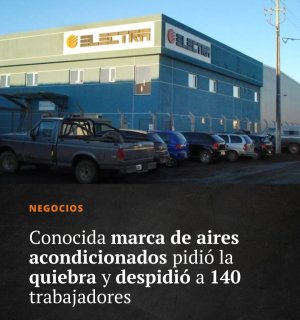
This is exactly what so many people in Argentina are complaining about right now. If local factories are allowed to just white label and rebrand finished imports and sell them at an absurd markup in a captive market, then everyday consumers should absolutely have the right to import those same goods directly for cheaper from China.
The real issue is the token assembly loophole. You have companies importing 90% of a product, doing a bare minimum 10% of the assembly locally, and then slapping an "Industria Argentina" label on it just to justify those massive protectionist margins. This unfair advantage is exactly what set the stage for the current public backlash against domestic manufacturers.
Anyone who thinks Milei somehow "duped" the entire country into hating local industry really needs to look deeper into how this system actually works. People are just tired of the racket. Honestly, passing off marked-up Asian imports as local manufacturing destroys the goodwill and reputation of the Argentine companies that are actually trying to build quality goods from the ground up.
It really comes down to a simple choice. The government should either protect a full, genuine domestic assembly line until it can actually compete globally - gradually opening up the market once it does - or just let consumers freely import the products that local industry clearly has no intention of ever making from scratch.
It is factually lazy to accuse Peabody of simply being a shell company that slaps new labels on finished Chinese imports. The company operates a massive facility in La Matanza that employed 325 workers. While some of you might not understand the exact nuances of their assembly line, it is entirely implausible and frankly insulting to suggest that a workforce of that size spends its entire day just swapping stickers on their items.
In practice, the reality on the ground speaks for itself: Peabody’s products are consistently a cut above the rest. There is virtually no overlap between what they produce and the generic, rebranded imports flooding the market. And it goes without saying they deliver high quality without demanding an absurd price premium, which is a stark contrast to the expensive, unreliable junk consumers have historically had to endure from legacy domestic brands like Patrick, BGH, Longvie, et al.
Dante Choi, the owner of Peabody (who famously built the company from the ground up in Fuerte Apache with the goal of becoming the "Apple of appliances"), recently called out the exact hypocrisy driving this crisis. He warned of an "avalanche of imports" entering the country with zero quality control and slashed tariffs.
The government has enthusiastically opened the floodgates for finished foreign goods, yet refuses to reduce the crippling tax burden -including severe VAT and provincial taxes on the imported components that local factories actually need to manufacture their own products. You cannot force local industry to compete globally while keeping their hands tied behind their backs with domestic taxes.
Some critics have absurdly tried to spin Peabody entering into a
concurso preventivo (protective bankruptcy) as a positive strategic move or a simple "opportunity". It is not. It is a desperate survival mechanism for a suffocating company. Anyone framing this as a positive business tactic should remember how well that exact "opportunity" worked out for Garbarino, which ultimately ended in total liquidation.
Peabody is not an isolated failure; it is a symptom of a deliberate macroeconomic policy. Look at the wider devastation across the sector:
- Whirlpool's Exit: In November 2025, Whirlpool completely shut down its state-of-the-art washing machine plant in Pilar—a facility that had just opened in 2022—firing 220 workers due to falling sales and import competition.
- Mabe's Downsizing: Mabe is currently undergoing a massive "restructuring" just to stay afloat.
The numbers expose the stark reality of this deindustrialization:
- Over the last two years, Argentina’s manufacturing sector collapsed by 7.9%.
- Globally, this was the second-worst decline in the world, surpassed only by Hungary.
- This is not a global trend; it is a localized policy failure, as during that exact same period, Brazil's industry expanded by 3.5%, Chile by 5.2%, Peru by 6.5%, and Uruguay by 3.7%.
This is Mileinomics working exactly as intended. The explicit objective is the erasure of the Argentine industrial base. As one ruling party senator openly admitted, the goal is to strip the economy down to raw extraction: agriculture, livestock, mining, and oil -or as he put it, relying solely on "What God gave us".
You can watch some interviews with Dante Choi here:
Dante Choi, el industrial argentino de origen coreano que dirige una de las empresas más importantes del rubro en el país, mostró su preocupación por la apertura del comercio exterior e hizo una autocrítica

www.infobae.com
Do Sun Choi es el dueño de Peabody. Críticas al Gobierno, la crisis de las pequeñas y medianas empresas y el objetivo de la competitividad
www.infobae.com