

BuySellBA
Administrator
Rents in Buenos Aires are skyrocketing: they've risen by 423% and are double the rate of inflation since 2023 - Ambito Financiero

Source:

Alquileres sin freno en CABA: subieron un 423% y duplican la inflación desde 2023
Así lo confirmó un análisis privado, que mostró que el costo de la vivienda registra aumentos muy por encima de la inflación acumulada.
 www.ambito.com
April 15,2026
This was confirmed by a private analysis, which showed that housing costs are increasing well above accumulated inflation.

Woman holds her head in her hands in protest against rising rent and utility costs, in a context where housing costs far exceed inflation.
The cost of renting in Buenos Aires is among the sectors with the greatest increase in the last two years. A report from the Center for Studies for Argentine Recovery (Centro RA) at the Faculty of Economic Sciences of the University of Buenos Aires shows that the housing, services, and fuel category has registered a 423% increase from December 2023 to February 2026.
The figure is well above the overall inflation rate for the period, which hovers around 209% in Greater Buenos Aires according to INDEC. The difference represents a jump of 191 percentage points, positioning housing costs as the main factor putting pressure on incomes.
Within this sector, rents show one of the largest increases, with a cumulative rise of 423%. This trend is not limited to the rental price alone, as associated services also have an impact (including building maintenance fees, which now average $250,000 in the City of Buenos Aires). Water has risen by 366%, electricity by 370%, and natural gas has jumped by 766%, the largest increase within the category.
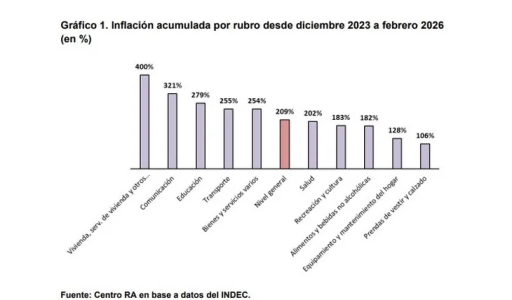
Source: Center for Studies for the Argentine Recovery (Centro RA) of the Faculty of Economic Sciences of the University of Buenos Aires
This behavior redefines the structure of household spending. Housing ceases to be just another component of the budget and takes center stage, with a direct impact on purchasing power.
Uneven inflation across sectors
The report reveals a wide dispersion in price trends. While housing leads the increases, other sectors are advancing at a slower pace. Communications has registered a cumulative increase of 321%, followed by education at 279% and transportation at 255%.In contrast, food and non-alcoholic beverages show an increase of 182%, below the overall average. Household equipment and maintenance rises 128%, and clothing and footwear reaches 106%, placing them among the categories with the least variation.
The difference between categories shows that inflation does not have a uniform impact. Essential and regulated services account for the largest adjustments, while goods show a more contained dynamic.
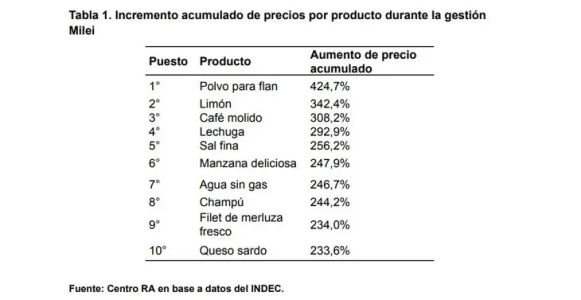
Source: Center for Studies for the Argentine Recovery (Centro RA) of the Faculty of Economic Sciences of the University of Buenos Aires
The analysis by product also reflects this heterogeneity. Flan powder leads the increases with 424.7%, followed by lemons at 342% and ground coffee at 308.2%. At the other end of the spectrum, sugar shows almost no change, while products like rice and noodles show low increases compared to the average.
The impact on the market and on households
The sharp increase in housing costs has direct effects on both the real estate market and household finances. The growing proportion of rent spent on disposable income limits the ability to save and reduces the margin for other expenses.At the same time, the pressure on tenants is reshaping demand. The search for more affordable units, relocation to lower-value areas, and downsizing are emerging as strategies to maintain access to housing.
The accumulated inflation rate of 209% acts as an average that masks significant differences between sectors. While gas prices have risen by 766% and rents by 423%, other products show much lower variations, such as sugar, which remains virtually unchanged. In this context, public services and housing account for the largest increases and explain a significant portion of the pressure on household incomes.
Behind these figures lie concrete changes in daily life. The increased weight of housing and services within household expenses is forcing people to cut back on consumption, adjust their habits, and, in many cases, relocate to more affordable areas. Although inflation is slowing, price levels in these sectors remain high: gas prices have multiplied several times over, and rents are four times higher than at the end of 2023.
www.buysellba.com