

BuySellBA
Administrator
Mortgage loans fell 10% year-on-year: the real estate market is uncertain about its rebound - Ambito Financiero

Source:

Créditos hipotecarios cayeron un 10% interanual: el mercado inmobiliario duda sobre su rebote
En marzo se otorgaron 2.600 préstamos por u$s193 millones. El primer trimestre cerró con una baja del 11%. Al margen de tasas: la ejecución frena operaciones.
 www.ambito.com
April 15, 2026
In March, 2,600 loans totaling US$193 million were granted. The first quarter ended with an 11% decrease. Aside from interest rates, the slowdown in loan disbursement is hindering operations.

A hand holds up a house as pieces fall around it: the image reflects the fragility of mortgage credit in a scenario where access exists, but remains conditioned by rates, income, and approval times.
Mortgage lending is showing signs of cooling after the rebound at the end of 2024 and mid-2025 . March figures reported by the Central Bank reflect this change in pace: 2,600 loans were granted for US$193 million, a 10% drop compared to the same month last year.
The first quarter ended with an 11% year-on-year decline. Between January and March, 1,100 fewer loans were granted than in the same period of 2015. This figure marks a break in the recovery trend that had taken hold last year.
The phenomenon raises questions about the sustainability of the system in a context where credit has returned, but is still far from consolidating as a massive tool for accessing housing.
A system with structural limits
Federico González Rouco , an economist specializing in the real estate market and with Empiria Consultores, explained that the slowdown is not due to a drop in demand. “The problem isn't demand, which is high, but rather the supply of credit. There's a lack of long-term financing,” he explained.The central issue is structural. Banks lend for terms of up to 25 or 30 years, but they finance themselves with short-term deposits. This mismatch limits their ability to sustain credit growth.
“The Argentine financial system lacks a long-term capital market. Without that, mortgage lending will always be limited,” González Rouco stated.
According to the specialist, the recent increase in the cost of money has paralyzed loan applications, bringing activity to a standstill. “With the rate hikes, most banks have been left with no applicants; today we're seeing a flow of loans that represents the bare minimum going forward.”
According to González Rouco, the phenomenon stems from a structural depletion of bank loan portfolios that had been accumulating since the 2024-2025 period. The economist emphasized that there are no signs of an immediate change in this trend and dismissed the more optimistic views that predicted an explosion in the sector. “I imagine credit will remain at these levels for a couple of months, until the rate cuts that began at the end of the year take hold; I don't foresee a credit boom at all ,” he explained.
In this scenario, Banco Nación maintains a dominant role. Of the approximately 60,000 loans granted in the last two years, around 27,000 came from this institution. The public bank's share has grown as other institutions have contracted, facing greater liquidity constraints.
Interest rates also play a role. While the Banco Nación's rates hovered around 6%, those in the private system are at higher levels, which directly impacts the monthly payment and the income required to qualify.
Access, in fact, remains limited. With current income levels, only a small portion of the population can meet the requirements. Various estimates place it at around 20% of households.
Even so, the current context is less restrictive than in previous years. “Credit is less inaccessible than before, but it remains very limited in structural terms,” the economist stated.
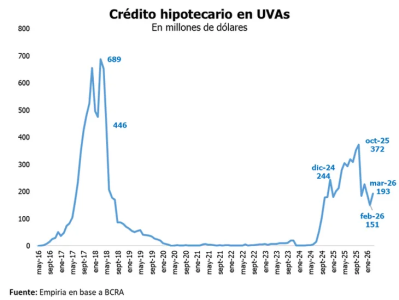
Source: Empiria Consultores based on data from the Central Bank of the Argentine Republic
The distribution also shows imbalances. Most loans are concentrated in the City of Buenos Aires, Córdoba, some areas of Buenos Aires Province, and higher-income regions. In much of the rest of the country, credit remains virtually nonexistent.
Political noise and real access
The debate surrounding loans has also gained momentum in recent weeks due to cases of officials and legislators from the Libertad Avanza party who obtained financing from Banco Nación. On this point, González Rouco drew a distinction between political and technical analysis.“There is not enough information to evaluate each case. From a technical standpoint, there are situations where the income can justify those amounts, especially if family income is considered,” he explained.
A loan of $400 million, for example, implies a monthly payment of approximately $2 million, requiring an income of around $8 million per month. Therefore, the analysis must be done on a case-by-case basis.
Andrés Salinas , an economist and professor at the National University of La Matanza (Unlam), explained that the decline in UVA mortgage loans is mainly due to a significant tightening of access requirements. “This new wave of loans began in the second half of 2024, with an average interest rate of 5.6% and disbursement periods of around 45 days,” he noted.
In that context, he explained that the deeds signed in March 2025 correspond to loans approved between December 2024 and January 2025, when the rate was still below 7% and there were no major restrictions on scoring: “As a reference, Banco Nación required around 550 points, a widely achievable level.”
However, Salinas pointed out that the scenario changed drastically in 2026. “During the same period, the average interest rate climbed to 11.7%, and Banco Nación—which holds approximately 80% of the loans granted—raised the required credit score above 906 points,” he stated. According to the economist, this increase in interest rates, combined with stricter lending requirements, “marks a clearly restrictive difference in the barriers to entry between one point in time and another,” which explains the sharp decline in access to credit.
Looking ahead to the coming months, Salinas believes demand remains strong, but that the key will be supply. He stated, “People’s interest has already proven to be high and constant; it’s up to the supply side to become more flexible in order to absorb it, as long as the business remains profitable for the banks.”

Amid calculations, dollars, and doubts, the decision to take out a mortgage is back in the spotlight, marked by uncertainty about rates, requirements, and market trends.
Along those lines, he noted that rates began to fall after the peak recorded in November 2025 and that there is still room for further reductions, although they are unlikely to return to initial levels, with Banco Nación "setting the standard" at around 6%.
“The positive thing is the trend,” he said. “If rates had remained around 15%, it would have been a sign of disinterest from the banks. But the fact that they are working to improve conditions shows that the product remains attractive.”
Banks lower rates and reconfigure the mortgage landscape
In recent weeks, the mortgage market has begun to show a change in trend. After a period of increases that had cooled demand, several banks adjusted their rates and conditions in an effort to revive lending.The losses were recorded in entities such as Ciudad, BBVA and Santander, while other players, such as ICBC, came out with more competitive offers to attract demand in a still selective context.
The result is a new, more competitive, though still fragmented, rate map, where more accessible proposals coexist with others that remain at high levels.
In this scenario, Banco Nación remains the benchmark, with rates around 6% + UVA for those who deposit their income, which positions it as the main driver of credit at present.

A couple finalizes the purchase of their home: this image is being repeated in the market, driven by the return of mortgage credit, although still with a limited reach.
Mortgage rates today below
- Banco Nación: 6% + UVA.
- Banco Ciudad: from 7.5% + UVA (rates between 9% and 9.5% depending on profile and area).
- BBVA: between 7.5% and 10.9% + UVA.
- Santander: 9.5% + UVA.
- ICBC: 6.9% + UVA (with earnings) / 9.9% (without earnings).
- Banco Patagonia: 12.5% + UVA.
- Banco Galicia: 15% + UVA.
- Supervielle: 15% + UVA.
- Banco Macro: 15% + UVA.
- The rate range is from 6% to 15%, with strong dispersion.
- Downward trend due to increased competition.
- Better conditions for customers with proof of income.
- Financing of up to 80% in some cases.
- Marked differences according to profile and scoring.
The obstacle lies in the execution
The analysis adds another key factor: execution. Beyond the conditions, many deals fail to materialize.Matías Bettatis , president of Bettatis Real Estate Advisors, stated that the main problem with credit today is not the interest rate, but how it actually works. “There are inquiries, there is interest, but many transactions never close,” he noted.
In their view, credit still functions more as an expectation than as a consolidated tool. The gap between what is announced and what actually happens in the market remains significant.
The process also changed. Digitization streamlined stages, but reduced support. In a complex operation, this lack of coordination impacts the results.

Income level determines access: with installments starting at $850,000, salary recovery is key to sustaining the mortgage loan.
“Credit is not just an interest rate. It’s a system involving banks, notaries, and real estate agencies. If that coordination fails, the transaction doesn’t move forward,” he said.
Timing plays a crucial role. With all the paperwork in order, a transaction can move forward in about 90 days. When obstacles arise, the timelines are extended and the risk of failure increases. "Today, loans represent between 11% and 13% of transactions, a low level compared to more developed markets," said Bettatis.
Future
The outlook ahead depends on several factors: macroeconomic stability, capital market development, and the financial system's ability to generate long-term funding.Sources within the national government also suggested that, following the scandal surrounding loans granted by Banco Nación, they are considering introducing changes to expand access to credit. In this context, the real estate sector emphasizes that wage recovery is key to sustaining demand , as current installments start at $850,000 and increase according to the loan amount, interest rate, and term.
Coordination between actors and the ability to transform demand into concrete actions also play a role. Bettatis summarized the central point:
Bettatis argued that today, mortgage lending still operates more as an expectation than as a fully established tool. In this context, he concluded that "the challenge lies in ensuring the system functions consistently and predictably, transforming that expectation into a real means of accessing housing."
www.buysellba.com