

BuySellBA
Administrator
50% of inquiries in Greater Buenos Aires are related to mortgage loans: how is the real estate and rental market performing? - Ambito Financiero

Source:

El 50% de las consultas en el GBA son con crédito hipotecario: cómo sigue el mercado inmobiliario y alquileres
Inmobiliarias del conurbano detectan mayor protagonismo del financiamiento en la demanda y un escenario con oferta limitada, precios y diferencias por zona.
 www.ambito.com
April 15, 2026
By Jose Luis Cieri
Real estate agencies in the greater metropolitan area are detecting a greater role for financing in demand and a scenario with limited supply, prices, and differences by area.
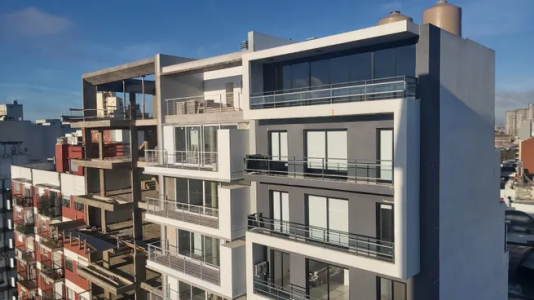
Avellaneda shows a dynamic and recovering real estate market in terms of sales transactions
Several real estate agencies in Greater Buenos Aires agree on a statistic that is beginning to clarify the current situation: five out of every ten inquiries about buying a property are related to the possibility of qualifying for a mortgage . Financing is re-emerging as a central factor, albeit still with restrictions, and is redefining demand patterns.
The phenomenon not only impacts sales but also affects the rental market , where the inability to access homeownership keeps pressure on demand. In this context, prices remain firm, especially in areas where supply is failing to keep pace with population growth and new housing needs.
Overall, the most recent data from the joint survey by Mercado Libre and the University of San Andrés (UDESA) reflect a market in transition. In March 2026, sale prices in dollars per square meter showed month-on-month increases of 2.3% in Greater Buenos Aires North, 0.7% in Greater Buenos Aires South, and a decrease of 0.5% in Greater Buenos Aires West in the house segment. For apartments, the variations were 2.3% in the north, -0.1% in the south, and 0.3% in the west. In rentals, apartment values in pesos increased by 1% in Greater Buenos Aires North, 1.5% in Greater Buenos Aires South, and 0.7% in Greater Buenos Aires West.
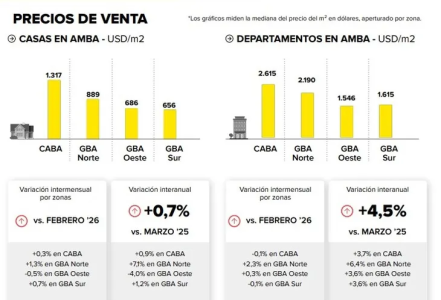
Source: Mercado Libre and Universidad de San Andrés (UDESA). The values shown here are for the AMBA region, which includes the City of Buenos Aires and Greater Buenos Aires.
Meanwhile, the report also shows that, year-on-year, apartment sales prices have risen by 6.4% in Greater Buenos Aires North and by 3.6% in both Greater Buenos Aires South and Greater Buenos Aires West. For houses, the trend is more varied: increases of 7.1% in the north, 1.2% in the south, and a decrease of 4% in the west.
In rentals , year-on-year increases exceed 29% in apartments in all areas of the greater metropolitan area, with peaks above 30% in some cases.
Southern zone: pressure due to lack of available locations
Fernando Belvedere , of Belvedere Propiedades, explained that the rental market dynamics in the southern suburbs of Buenos Aires are almost entirely due to a structural supply constraint. He specified that districts "like Avellaneda and Lanús have suffered from a decade of low levels of multi-family housing development, resulting in a limited stock in the face of sustained demand."He indicated that the imbalance between supply and demand has a direct effect on prices. He explained that each unit entering the market receives numerous inquiries and quickly reaches high prices. He stated that this is not a temporary phenomenon, but rather a logical consequence of a market that has not incorporated enough new product.
He added that, unlike other areas with higher turnover, in the southern suburbs the market is structurally short of supply, which reinforces competition among tenants and sustains the upward trend in prices.
Regarding the regulatory changes, he explained that the new system has restored predictability for landlords, although it has also raised the bar. He commented that today landlords prioritize stronger profiles and more flexible contracts, which reduces the number of potential transactions and tightens the entry requirements.
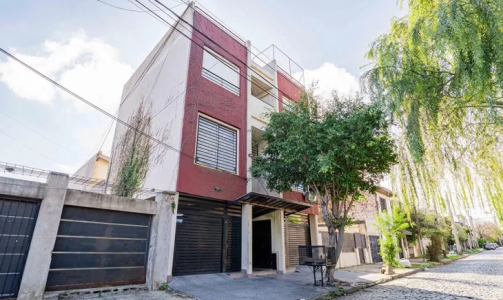
Lisandro Mendez 3400, in Remedios de Escalada, Lanus district. A highly sought-after area.
Belvedere also noted that "the market has become more selective. Properties that don't meet minimum quality or price standards are quickly priced out of the market." He explained that this increased professionalization impacts both rentals and sales.
Regarding prices, he specified that rents in the southern area are located at:
- 1 bedroom: $350,000. – $550,000.
- 2 bedrooms: $500,000. – $800,000.
- 2-bedroom houses: $600,000 - $900,000.
- 3-bedroom houses: $800,000 - $1,300,000.
He indicated that the market has stopped validating inflated prices. He explained that "properties that are correctly appraised manage to close deals within reasonable timeframes, while those that are out of sync with the market remain stagnant." He emphasized that the gap between the asking price and the closing price tends to narrow.
In terms of values, he explained:
- 1 bedroom: US$45,000. – US$80,000.
- 2 bedrooms: US$70,000. – US$120,000.
- 2 bedroom houses: US$80,000. – US$150,000.
- 3-bedroom houses: US$120,000. – US$250,000.
Northern zone: prices seeking equilibrium
In the northern suburbs, the dynamics show a readjustment without the 2020 Rental Law. Daniel Salaya Romera , of Salaya Romera Propiedades, explained that "the adjustments in rental values largely respond to the correction of contracts that were delayed," referring to the impact of the previous scheme.As he explained, “following the regulatory framework change, prices aligned with more sustainable profitability levels,” which allowed for a better balance for owners. In that regard, he indicated that “profitability increased from around 2% annually to levels around 5%,” a factor that encouraged the return of units to the market.
From his perspective, this process led to a structural change in supply. “This change generated a significant increase in available supply,” he stated, adding that the market is beginning to show signs of greater equilibrium.
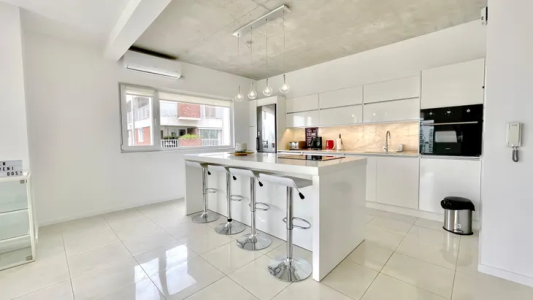
Kitchen with island and exposed concrete ceiling in a house located in Vicente López, the most sought-after area in northern Greater Buenos Aires today.
Salaya Romera Properties
Along those lines, he maintained that "rental values are beginning to find a point of equilibrium," with demand gaining room for negotiation. He even remarked that "in some cases, prices tend to stabilize."
Analyzing the territorial dynamics, he highlighted that the most established corridors continue to lead in terms of property values. “Areas like Vicente López, Olivos, La Lucila, Martínez, and San Isidro concentrate the highest values,” he noted, while linking this behavior to “connectivity, urban quality, and the presence of services.”
In the sales sector, the executive described a scenario with less available supply. “Many owners withdrew units from the market to offer them for rent,” he stated, attracted by the improved rental income. He added that there is also a stock of properties waiting to see if prices will rise.
Regarding the role of financing, he considered that "mortgage loans help to boost transactions," although he clarified that their reach is still limited. "Demand is showing greater decisiveness, with buyers prioritizing concrete opportunities," he added.
In terms of value, he detailed that used apartments are priced between US$2,500 per m2 and US$3,500 per m2, while brand new units reach US$3,600 per m2 and US$5,000 per m2.
West Zone: Demand focused on used
With a more heterogeneous behavior, the western suburbs reflect a market conditioned by access to credit and the specific characteristics of each area, especially in Ituzaingó, Castelar, and Moreno. Paola Sessarego , from the Vaccaro Group, explained that "the pressure on rents is linked both to supply and to the difficulty of accessing homeownership."In that context, he noted that "many households remain in the rental market due to the impossibility of moving towards purchase," which sustains demand and limits any significant price correction.
Regarding regulatory changes, he indicated that "the easing of conditions encouraged the addition of new units," although he clarified that prices remain firm. "They are maintained based on the quality, location, and characteristics of each property," he stated.
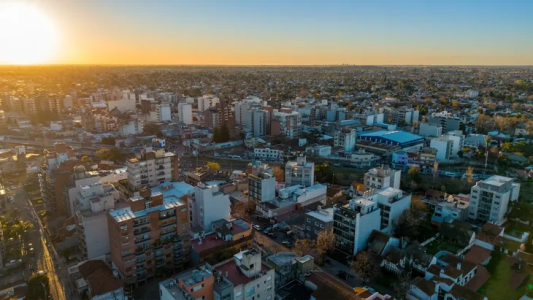
Castelar in the Morón district, one of the most sought-after locations in the western part of Greater Buenos Aires.
According to their analysis, the market shows strong segmentation. “Values vary significantly between gated communities and open areas,” they explained, adding that factors such as the level of infrastructure, security, and amenities also play a role.
In that context, he detailed that rents in gated communities range between US$700 and US$1,100. While outside these environments, prices range between $600,000 and $1,200,000.
In the sales segment, he described a clear trend. “The balance is tipping towards used properties,” he stated, although he warned that “little by little, with off-plan financing, interest in new properties is returning.”
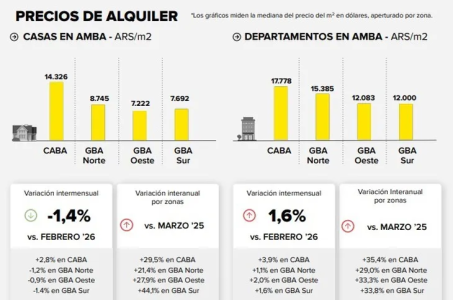
Source: Mercado Libre and Universidad de San Andrés (UDESA). The values shown here are for the AMBA region, which includes the City of Buenos Aires and Greater Buenos Aires.
He also pointed out that the price dispersion is due to multiple variables. “It depends on the location, the condition, the size, and the level of comfort,” he explained, while emphasizing that the market presents opportunities but requires further analysis.
In terms of value, he indicated that apartments range from US$60,000 to US$320,000, while houses range from US$120,000 to US$450,000.
Sessarego concluded that “the western market remains active, but with more selective buyers,” and noted that decisions “are increasingly conditioned by access to financing and the price-quality ratio.”
www.buysellba.com