Explore, connect, thrive in
the expat community

Expat Life: Local Discoveries, Global Connections

Are salaries this low for expats or locals???

I wouldn't say impossible, but definitely very hard without high-level fluency in English and a solid cybersecurity background. Out of the eight of us in Argentina, only one hadn't lived in an anglophone country before, but even that one exception has parents living in Ireland. Everyone else had lived and/or worked in the US or Canada for a few years, and the team lead was a Canadian who has been here for 15 years.

When we all had to do our mandatory English exams to see if we needed extra training, the one with the worst English on the team had a solid B2 spoken and C2 written level.
Did you say Ireland? I just posted about Argentina having a large Irish population.
 
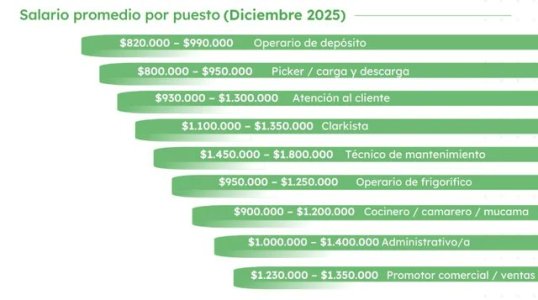
I saw this survey online today but I don't know how credible it is. It says the average private sector salary closed 2025 at
1,798,332 pesos ($1,225 USD) per month, with a year-over-year variation of 44.34%, according to a survey conducted by Grupo Ceta, based on information collected from job posting monitoring, employment surveys, and official data.


G_R3DmXWgAEtwrA.jpeg
 
I saw this survey online today but I don't know how credible it is. It says the average private sector salary closed 2025 at
1,798,332 pesos ($1,225 USD) per month, with a year-over-year variation of 44.34%, according to a survey conducted by Grupo Ceta, based on information collected from job posting monitoring, employment surveys, and official data.


View attachment 10244
Doubt these figures are right. Never heard of Grupo Ceta. Funny they are quoting average at almost 1.8 million pesos and all of this graphic for the different positions are all far below that. 😛
 
I saw this survey online today but I don't know how credible it is. It says the average private sector salary closed 2025 at
1,798,332 pesos ($1,225 USD) per month, with a year-over-year variation of 44.34%, according to a survey conducted by Grupo Ceta, based on information collected from job posting monitoring, employment surveys, and official data.


View attachment 10244
Send me where I can send my friends for all these jobs paying so high. Tons of my friends are unemployed and looking for jobs. The salaries look correct from this chart but not sure if the "average" is as high as they are saying except for professional jobs.
 
I saw this survey online today but I don't know how credible it is. It says the average private sector salary closed 2025 at
1,798,332 pesos ($1,225 USD) per month, with a year-over-year variation of 44.34%, according to a survey conducted by Grupo Ceta, based on information collected from job posting monitoring, employment surveys, and official data.


View attachment 10244
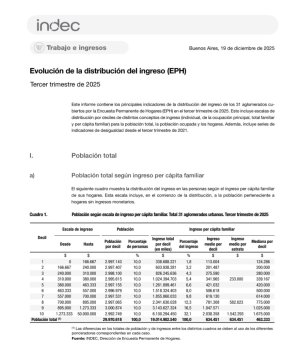
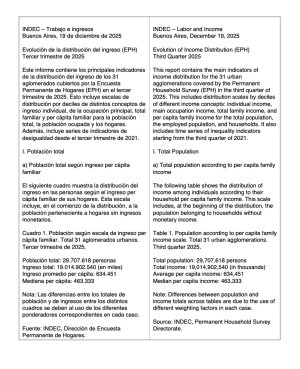
It's tough here because so much of the economy is under the table. But according to government statistics the numbers aren't pretty. Read another post. @Jakoval said it best. Third world salaries and first world prices.


Screenshot 2026-01-22 at 2.57.02 PM.jpg

Screenshot 2026-01-22 at 2.58.43 PM.jpg
 
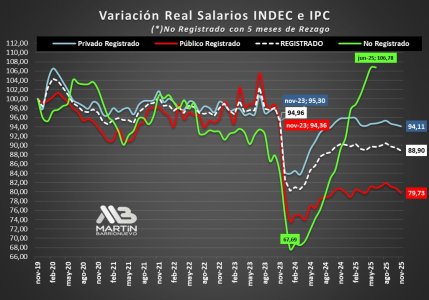
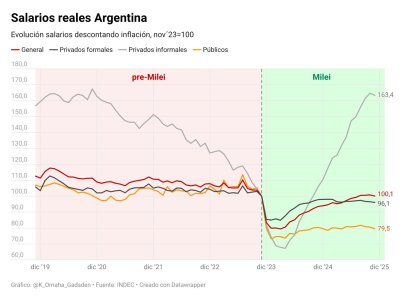
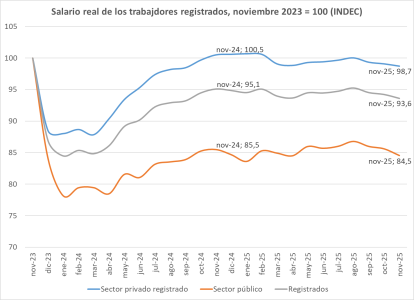
The numbers from INDEC don't look good. Looks like the formal economy employment salaries are falling now. Registered workers look like they are below the baseline. The numbers are the numbers. Private formal workers look about 6% the base, total registered 11% below and public sector workers 20% below. After 2 years of adjustment under Milei the majority of formal workers still hasn't recovered their purchasing power. That doesn't sound like a real turn away to me.

Public sector is dead. Collapsed in late 2023 when Milei took over and never rebounded. If fiscal adjustment is being financed by shrinking public salaries in real terms then for millions of workers, living standards are structurally lower.

November shows another drop in real wages. Registered wages are dealing again and not stabilizing.

Even after inflation slowed down, wages are slipping again.

The jump up in informal wages good news bad news. Good that people in the black can get jobs but sort of means that if informal wages are outperforming formal wages then the labor market is distorted and broken. This is NOT a sign of a healthy working economy. This does not seem healthy to me.

So even if macro indicators improved, workers haven't returned to their prior purchasing levels prior to Milei.


G_YS3PrXIAAlwXw.jpeg
 
The numbers from INDEC don't look good. Looks like the formal economy employment salaries are falling now. Registered workers look like they are below the baseline. The numbers are the numbers. Private formal workers look about 6% the base, total registered 11% below and public sector workers 20% below. After 2 years of adjustment under Milei the majority of formal workers still hasn't recovered their purchasing power. That doesn't sound like a real turn away to me.

Public sector is dead. Collapsed in late 2023 when Milei took over and never rebounded. If fiscal adjustment is being financed by shrinking public salaries in real terms then for millions of workers, living standards are structurally lower.

November shows another drop in real wages. Registered wages are dealing again and not stabilizing.

Even after inflation slowed down, wages are slipping again.

The jump up in informal wages good news bad news. Good that people in the black can get jobs but sort of means that if informal wages are outperforming formal wages then the labor market is distorted and broken. This is NOT a sign of a healthy working economy. This does not seem healthy to me.

So even if macro indicators improved, workers haven't returned to their prior purchasing levels prior to Milei.


View attachment 10260

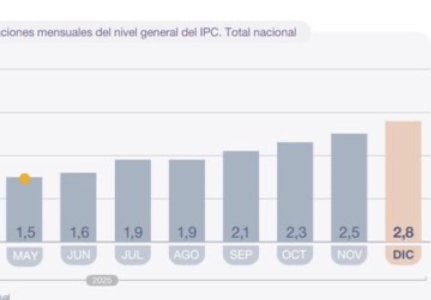
Excellent analysis. Many can't keep up even with a slowdown in inflation. While inflation has slowed, some bills went up 4x what they were before. If inflation accelerates which is what it looks like it is doing the past few months, so wage gains are eaten up immediately

For a real turn around monthly inflation has to go down and stay down month after month. Without price stability, wage recovery is not possible.

It's not enough for inflation to stop going up. Argentina needs consecutive quarters where negotiated wages BEAT inflation each month. Argentina's own INDEC numbers show that wages are lagging. Wage negotiations must be above CPI and stay about CPI for a few cycles which I don't see happening.

I don't see private sector growing and hiring. I don't see rising productivity. I don't see much business investments besides oil and gas. None of this show anything that would resemble a true turn around.
 
Excellent analysis. Many can't keep up even with a slowdown in inflation. While inflation has slowed, some bills went up 4x what they were before. If inflation accelerates which is what it looks like it is doing the past few months, so wage gains are eaten up immediately

For a real turn around monthly inflation has to go down and stay down month after month. Without price stability, wage recovery is not possible.

It's not enough for inflation to stop going up. Argentina needs consecutive quarters where negotiated wages BEAT inflation each month. Argentina's own INDEC numbers show that wages are lagging. Wage negotiations must be above CPI and stay about CPI for a few cycles which I don't see happening.

I don't see private sector growing and hiring. I don't see rising productivity. I don't see much business investments besides oil and gas. None of this show anything that would resemble a true turn around.
100%! Great posts. Here is a graph with pre-Milei and post Milei.

G_XuHeQXAAA2hno.jpeg
 
And inflation is going up. So Libertarians needless to say understandable why there are significantly less Milei cheerleaders online vs before. I noticed on X hardly anywhere is so excited like before. Painful process fixing things but these show the poorest look like they are benefiting the most at the expense of the middle and upper classes.

G_X-Si3XYAAsxlR.jpeg
 
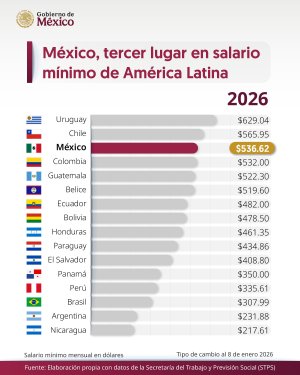
You have idiots on both sides of the political party in all of these countries that cheer on their candidate. Salaries in Argentina are at third world levels and prices are at first world prices. No one can argue that. Make it make sense because it does not. @Jakoval said it best in his post. Slave wages at 1st world prices.

G_YF8HzXoAACqDf.jpeg
 
The numbers from INDEC don't look good. Looks like the formal economy employment salaries are falling now. Registered workers look like they are below the baseline. The numbers are the numbers. Private formal workers look about 6% the base, total registered 11% below and public sector workers 20% below. After 2 years of adjustment under Milei the majority of formal workers still hasn't recovered their purchasing power. That doesn't sound like a real turn away to me.

Public sector is dead. Collapsed in late 2023 when Milei took over and never rebounded. If fiscal adjustment is being financed by shrinking public salaries in real terms then for millions of workers, living standards are structurally lower.

November shows another drop in real wages. Registered wages are dealing again and not stabilizing.

Even after inflation slowed down, wages are slipping again.

The jump up in informal wages good news bad news. Good that people in the black can get jobs but sort of means that if informal wages are outperforming formal wages then the labor market is distorted and broken. This is NOT a sign of a healthy working economy. This does not seem healthy to me.

So even if macro indicators improved, workers haven't returned to their prior purchasing levels prior to Milei.


View attachment 10260
Thanks @sophos and @Allah for your observations. It made me research seeing your posts and it looks like indeed this is a trend no noise.

That is an entire quarter now (3 consecutive months) of registered wages falling. One bad mouth could be chalked up as seasonal. Two maybe lagging negotiations but 3 seems to signal to me that wage recover has not only stalled but maybe even reversed on the recovery. In inflation has slowed but wages are still falling in real terms it means the sh*t is going to hit the fan in the near future as nominal adjustments aren't keeping up pace.

Private sector salaries are now below November 2023 in nominal terms. So after the shock adjustment, inflation cooling and a year of stabilization private formal workers are worse off than before Milei took office. This is a big deal! It explains why people aren't so hot for Milei even if they say they are or will give him some more time. Stabilization without income recovery feels like austerity without payoff.

Public sector salaries are down 15.5% YoY which is huge! And vs. 2017 public workers have lost 35.6% of purchasing power. Crazy. Agree they needed to cut spending and get rid of noquis but the public employees are basically financing the stabilization. From a macro perspective it reduces the deficit like we are seeing but from a house-house spending perspective it is devastating!

Just looking at the numbers and charts even from before Milei private sector "real wages" are down 22% from 2017. This shows that Argentina hasn't delivered sustained real income growth in almost 8 years. So even if Milei stabilizes things, he inherited a structural erosion that may not be fixable in the time he has left (2 years). Let's see if the people will give him more time after his 2 years left.

His narrative was pain first then recovery. All the data shows up bloody pain, recovery is happening but momentum is weakening.

A real turn around needs sustained real wage growth many months in a row, no stagnation, no YoY losses and no multiple month declines. Looking at all the data you can't argue any of this is happening yet.


G_XxfJpWMAAvExR.png
 
Bravo gentlemen. Good data. This explains why default rates are sky high now in Argentina. I just posted about this.

 
Last edited:
Bravo gentlemen. Good data. This explains why default rates are sky high now in Argentina. I just posted about this.

I just read your post about people falling behind on credit card and loans. That is usually a good indicator how things are going.
 
creating loans for paying expenses ( subprime) is like asking someone about to be hung if he was to sign up for a credit card. cant imagine what the interest is
 
creating loans for paying expenses ( subprime) is like asking someone about to be hung if he was to sign up for a credit card. cant imagine what the interest is
Uncle Wong posted the article. It says 60% APR. Ouch! I just talked to someone that is applying for one. The bank is protected and can get a lien but the problem is this takes years but the owner can't sell it without them getting paid and there are huge interest and penalties if you are late so probably a very safe loan for the banks.

 
Looks like press is starting to post realistic picture of how things are going. Nominal wages have gone down and not matching inflation.


Prices are totally out of whack with how little the wages are. $2.25 USD for a yoghurt. This is more expensive than what I'd pay in a major city in a first world country. Unless salaries go up this is not going to end up well. Another crash coming.

IMG_1926.JPG
 
Prices are totally out of whack with how little the wages are. $2.25 USD for a yoghurt. This is more expensive than what I'd pay in a major city in a first world country. Unless salaries go up this is not going to end up well. Another crash coming.
Yogurt prices in Argentina are absurd in a country with so much dairy and milk. Doesn't make any sense and the quality is terrible.


Activity has been totally stagnant since the beginning of 2025 and is at levels similar to those of 2023, but with very uneven trajectories between sectors, according to a study by the consulting firm Equilibra. Only 19 of 55 sectors grew, concentrated in finance, agriculture, energy, and the knowledge economy, while most of industry declined and lost market share to imports.In 16 of 20 tradable sectors in retreat, local production fell at the same time that external purchases grew.


Back
Top