

BuySellBA
Administrator
They build a 9-story building in which all the apartments are different - La Nacion Propiedades

Source:

Construyen un edificio de 9 pisos en el que todos los departamentos son distintos
Los desarrolladores enfrentaron un desafío inusual: innovar sin alterar la identidad de la zona y lograron un emprendimiento en el que hasta las piscinas están intervenidas por un artista
 www.lanacion.com.ar
April 20, 2026
By Candela Contreras
The developers faced an unusual challenge: to innovate without altering the identity of the area, and they achieved a project in which even the swimming pools have been decorated by an artist.
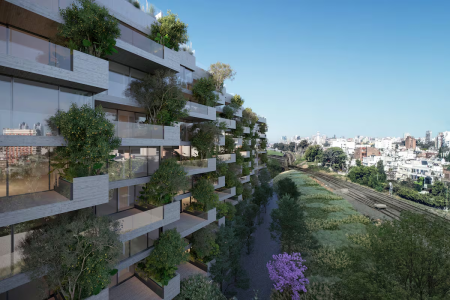
With an investment of US$160 million, the exclusive project in the area transformed previously unimaginable spaces with a unique artistic work.
Within Palermo lies an area recognized as one of the most exclusive and elegant sectors of Buenos Aires: Barrio Parque . It was originally designed by landscape architect Carlos Thays in 1912 and is characterized as a residential oasis within the city .
Among the main characteristics that make the area unique are : winding, narrow, and curved streets; abundant vegetation, with its centuries-old trees and small plazas; but above all, mansions and stately homes with diverse architectural styles that include French, English, German, and modern influences. And the market confirms this , not only with the price per square meter but also with a limited supply and a demand that seeks to continue living in a traditional home .
The idea of "continuing to live as if in a house" is the most difficult thing to achieve. When considering a new real estate project, a key question arises among developers: how do you innovate in such an exclusive sector without breaking its mystique? The challenge isn't building square meters, but rather capturing that sense of "belonging" that defines this area of Palermo Chico .
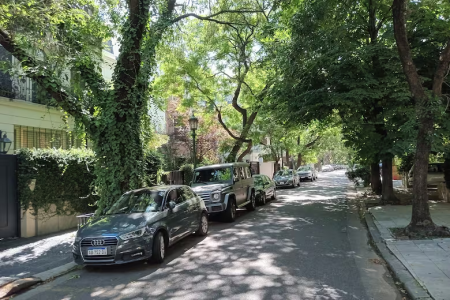
Barrio Parque is the most exclusive residential area in Buenos Aires with embassies, old houses and mansions. Gentleness
Under this premise, a new project is rising in the area, not seeking height , but rather unfolding horizontally in a nine-story, bar-like structure that stretches for almost two blocks—200 meters. The aim was clear: not to build a tower , but to create a “residential development with the soul of a house,” summarizes Gabriela Goldszer, director of Ocampo Propiedades, the firm in charge of marketing Line Ocampo. And in a neighborhood where identity matters as much as the price per square meter, this concept is not a detail: it is the entry requirement.
Along the same lines, Goldszer explains that “ a new project in such a traditional neighborhood always adds strength , vigor and modernizes it with a contemporary design that adds comfort, highly valued by end consumers who appreciate the location, but also what the project gives them.”
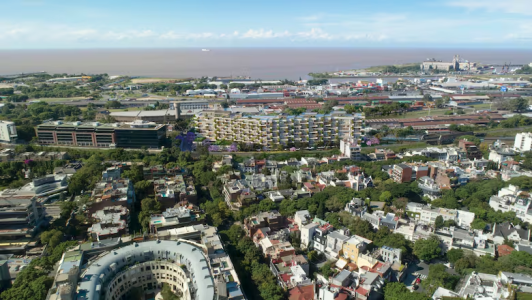
The Barrio Parque project unfolds horizontally in a "bar" structure with only nine floors in height
Living like in a house, but in a building.
The unique aspect of this project is that, to avoid the feeling of a hotel or a massive 55,000 m² building, the architects decided to fragment it . “Instead of the classic shared lobbies, the building has 23 elevator cores for its 120 units,” says Juan Martín Santagada, partner at Anchezar-Santagada, the firm carrying out the project.Furthermore, while traditional apartment architecture is based on a "typical floor plan" (one floor identical to the next), the developer opted for a layout rotated on two axes. The result is that no two units are alike: "Each space is unique," he affirmed. Even on the ground floor, the project pays homage to the neighborhood's original typology with four exclusive houses of up to 500 m², each with its own garden and independent levels.
With an investment of US$160 million , Line Ocampo has a total area of 50,000 square meters: 120 units ranging from 150 to 700 square meters, with terraces and gardens that are sold from US$8,000/m².
Located at Ortiz de Ocampo and Juez Tedín, it has nine floors, three basements and amenities: from a restaurant/bar to a gym, game room, event hall, courtesy parking and a mini-cinema, among others.
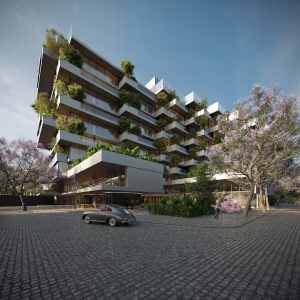
The 120 units in the development are all different. "No two are alike," says the developer.
The market seems to have validated this “evolution of the neighborhood” : with 80% of the units sold, the most curious phenomenon is the transformation of the buyer. “ Many of those who came in as investors in 2022 decided, seeing the construction progress, that the project would be their final residence ,” says the developer.
The development strategy aims to construct a narrative that engages with the surrounding environment . And that environment encompasses not only the neighborhood itself, but also what is presented within it, with art as a trend .
Furthermore, the presence of art in high-end real estate developments is becoming a key strategy for enhancing the prestige and symbolic value of projects , transforming residential and office spaces into cultural experiences. It is in this spirit that the Barrio Parque project decided to integrate a work of art into the building's common areas , blurring the lines between architecture, design, and experience within a high-end residential development.
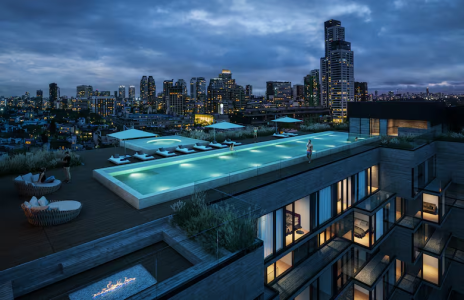
Of the three swimming pools included in the project, two of them will be artistically decorated.
Art as a turning point
“ Art adds value to a real estate project because it has always been linked to architecture in different ways and at different times,” says Leandro Erlich, an internationally recognized artist known for his installations that explore perception and the relationship between reality and illusion, with exhibitions in museums and cultural institutions around the world with works such as La Vue or Swimming Pool, and who participated with an intervention in the project.The artist, for the first time, transformed an unexpected space within a real estate development: the swimming pools . The official unveiling of the work, titled “Submerging the Gaze,” took place on March 18th at the development itself. The installation transforms water, surface, and reflection into a carefully considered composition, based on a central idea: the relationship between human beings and movement .
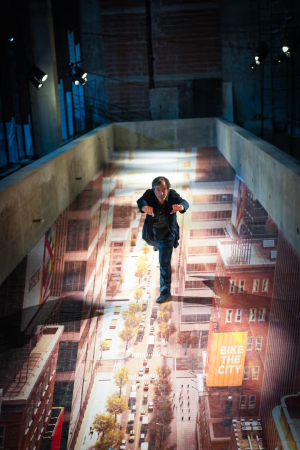
Leandro Erlich in the indoor pool of the building that reflects the image of a city
“On Earth, animals move in different ways: they crawl, swim, fly, and walk. Throughout history, humans, in addition to walking, also learned to swim and, much later, to fly . But flying always requires some kind of device,” Erlich explains. From this idea, the concept for the intervention was born: a space where the experience of swimming is symbolically transformed into the possibility of flying .
The artwork consists of two swimming pools—one indoor and one outdoor—that function as optical and sensory devices located in the building's basement, where most of the amenities will be found. With images evoking aerial views of an urban landscape —in the indoor pool— and a rural landscape —outside—, "the concept is to play a bit with a space that will be functional," explains the artist.
“I chose the rural (which resembles an Italian landscape) and the urban because they are the two worlds we inhabit, which have to do with cities and with nature. And, when I saw the two pools, they seemed like a perfect diptych to create a story,” says Erlich.
As he explains, creating the images, which will be printed with ceramic ink on the pool floors , was a challenge . The one of the countryside was created from real satellite photographs, while the one of the city is fictional.
But this won't be the only space where art takes center stage . Like the pools, the triple-height inner courtyard , also located in the basement, will become a stage where national design takes center stage . There, designer Cristian Mohadeb will transform the space with a work entitled "Floating Towers."
“The idea arose from a dialogue with the project to participate in this large-scale space. The building has a very orthogonal imprint, with straight and angular lines, so I sought to introduce softer elements that complement the structure and lighten the overall appearance ,” explains Mohadeb.
The artwork consists of three towers woven in Catamarca that will hang from the triple-height space , spanning the different levels so they can be appreciated from any point in the area. For the designer, the integration is organic: “A piece as unique as this complements the architecture; art and design always enhance the value of the built space.”
Both artists agree that this is a real estate project where "art is not approached from the status or decorative side, but from the experience, and that makes a project unique ."
www.buysellba.com