Chapter Two: The Service Entrance
The Plaza de Mayo was a black ocean of rain and whipping wind. The palm trees thrashed against the night sky, their fronds bending like broken umbrellas. Usually, the plaza was the city’s stage—a place for protests, for the beating of drums, for the furious chants of a populace that had learned to demand its survival at the gates of power.
Tonight, the plaza was empty. Even the anger of Buenos Aires had surrendered to the storm.
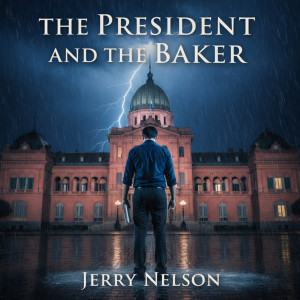
Pedro crossed the cobblestones, his boots sinking into deep puddles, the freezing summer rain pasting his hair to his forehead. Ahead of him loomed the Casa Rosada. It was an imposing, asymmetrical fortress, its famous pink facade washed out by the downpour, illuminated only by the harsh glare of halogen security lights.
He didn't walk toward the grand main entrance where the
Granaderos, the presidential guard in their ceremonial uniforms, usually stood stoic watch. He knew those doors were impenetrable. Instead, Pedro kept to the shadows of the Ministry of Economy building, skirting the edge of the plaza toward the eastern flank of the palace.
Years ago—before the hyperinflation, before his father’s heart gave out, before the neighborhood began to hollow—the bakery had briefly held a minor catering contract for the lower-level civil servants in the palace. Pedro remembered a secondary delivery bay on the side street, a heavy iron gate used for bringing in supplies and taking out the trash.
When he reached the gate, he pressed his face against the cold iron bars. The guard booth inside was empty. The lone security officer, seeking refuge from the sideways rain, had likely retreated into the deeper vestibule to smoke or watch a football match on a portable screen.
Pedro reached through the bars. His hand, thick-fingered and scarred from decades of pulling hot baking sheets, found the heavy padlock. It was latched, but the hasp it hung from was ancient, rusted out by decades of humid port-city air.
He stepped back. He looked down at the iron grating covering a storm drain at his feet. With a grunt of effort, he crouched, gripped the edge of the heavy grating, and hauled it upward. It weighed as much as a sack of wet flour. He swung it like a pendulum and brought the heavy iron edge crashing down against the rusted hasp.
Thunder cracked overhead, a deafening artillery strike of sound that swallowed the shriek of the breaking metal.
The hasp snapped. The padlock fell to the wet concrete.
Pedro pushed the gate open, slipped inside, and pulled it shut behind him. He was in.
He moved through the dimly lit service corridor. The air here was dry and smelled of floor wax, old paper, and stale coffee. It was a sharp contrast to the smell of ruin he carried with him. Water dripped from his canvas jacket, leaving a dark, glistening trail on the checkerboard tiles. He felt the heavy weight of his grandfather's revolver banging against his thigh, and the rigid spine of the notebook pressing against his ribs.
He climbed a narrow concrete stairwell, avoiding the elevators. One floor. Two floors. His breathing grew ragged, his knees aching. He was a baker, a man used to early hours and heavy lifting, but the adrenaline was making his chest tight, his pulse hammering a frantic rhythm in his ears.
When he finally pushed through a heavy wooden door on the second floor, the world changed.
He stepped onto a thick, plush crimson carpet. The walls were lined with oil paintings of serious men with sideburns and sashes. Crystal chandeliers hung from the soaring ceilings, casting a warm, golden light over the mahogany wainscoting. The silence here was absolute, insulated from the storm outside by thick double-paned glass and heavy velvet drapes.
It was the silence of power. The silence of spreadsheets and high-level meetings. It was a silence that had never known the sound of an empty cash register.
Pedro walked down the Hall of Busts. He didn't know exactly where the President's private office was, but he knew what to look for. He looked for the doors guarded not by history, but by men.
He turned a corner and saw them. Two men in dark suits, sitting outside a massive pair of carved double doors at the end of the corridor. The President's detail. One was reading a newspaper; the other was looking at his phone.
Pedro stopped. He put his hand in his pocket and closed his fingers around the cold, unfamiliar grip of the revolver. He took a deep breath, pulling the scent of the waxed floors and old power into his lungs. He didn't draw the weapon. He simply stepped out from the shadows and began to walk down the center of the crimson carpet, straight toward the heavy wooden doors.
Chapter Three: The Weight of the Room
Pedro did not run. A baker knows that rushing a fragile dough will only collapse it. He walked with the heavy, deliberate cadence of a man carrying fifty kilos of flour up a flight of stairs. Squelch. Squelch. His soaked boots left dark, muddy crescent moons on the pristine crimson carpet.
The two men in dark suits didn't notice him until he was less than twenty feet away. The plush carpet swallowed the sound of his approach, and the thunderstorm battering the tall windows masked his heavy breathing.
The guard on the right, the one scrolling on his phone, looked up first. His brow furrowed in sheer confusion. Pedro didn't look like an assassin. He looked like a drowned ghost—a broad-shouldered man in a cheap, dripping canvas jacket, his face gray with exhaustion.
"Hey," the guard barked, standing up quickly, his hand dropping toward the holster at his hip. "How did you get up here? Stop right there."
The second guard dropped his newspaper and sprang to his feet, instantly adopting a wide, defensive stance. "Hands! Let me see your hands!"
Pedro stopped. He was ten feet from the carved mahogany doors. He could see the brass handles, polished to a mirror shine. Behind those doors sat the man who had called his ruined life a "short-term adjustment."
Pedro pulled his hand from his deep pocket. The antique .38 revolver came with it.
He didn't point it at the guards. He just held it down by his side, the heavy, rusted metal glinting in the warm chandelier light. His hand was shaking, not from fear, but from a bone-deep cold and the sheer, absurd gravity of what he was doing.
The guards froze. In all their training, they had prepared for coordinated tactical assaults, for political extremists with automatic weapons, for bomb threats. They had not trained for a weeping, soaking-wet baker who looked more likely to drop dead of a heart attack than pull a trigger. That momentary cognitive dissonance—the sheer impossibility of this man standing in the most secure hallway in Argentina—bought Pedro three seconds.
"Don't," Pedro said. His voice was a gravelly rasp, ruined by years of breathing in flour dust and cheap tobacco. "I just need to talk to him. Just talk."
"Drop the weapon!" the first guard shouted, drawing his sleek, modern Glock. The metallic
shing of the gun clearing its holster echoed loudly in the corridor. "Drop it now!"
Pedro didn't drop it. He lunged.
He threw his heavy, wet body forward, not at the guards, but at the gap between them. The first guard reached out to grab him, but his hand slipped on Pedro's soaked canvas jacket. Pedro slammed his shoulder into the heavy mahogany doors. They weren't locked—the President was working late, and his detail was right outside.
The doors burst open. Pedro stumbled into the room, falling to his knees on an intricate Persian rug.
He scrambled up immediately, spinning around to face the doors. The guards were rushing forward, their weapons raised. With a desperate heave, Pedro slammed both heavy doors shut in their faces. He grabbed the thick brass deadbolt and threw it to the right.
Clack. An instant later, a heavy shoulder slammed against the outside of the door, rattling the frame, followed by furious shouting and the thud of fists against the wood.
Pedro leaned his back against the mahogany, gasping for air, the revolver still dangling loosely in his right hand.
"I wouldn't advise firing that in here," a calm, measured voice said. "The acoustics are terrible, and you'll ruin a very expensive painting."
Pedro slowly turned his head.
The office was vast, lined with towering bookshelves and illuminated by the soft glow of a green-glass banker's lamp. Behind a massive desk of carved lapacho wood sat the President of the Argentine Republic. He had taken off his suit jacket and loosened his tie. Spread across the desk in front of him were dozens of financial reports, bar charts, and economic forecasts—the infamous spreadsheets.
The President didn't look terrified. He looked profoundly irritated. He was a man accustomed to absolute control, and this intrusion was, above all else, a failure of his staff. He peered at Pedro over the top of his reading glasses, taking in the puddle of rainwater forming around the intruder's boots.
"Who are you?" the President asked, his voice steady. "And how much are they paying you?"
Pedro looked at the polished desk, the crystal decanter of water, the silver pen resting on a neat stack of papers. The distance between them was only fifteen feet, but it felt like a canyon spanning two entirely different planets.
Pedro reached into his wet coat with his free hand. The President tensed slightly, finally showing a crack of human instinct. But Pedro didn't pull out a bomb or another weapon. He pulled out the battered, black-spined school notebook.
He tossed it onto the pristine surface of the President's desk. It landed with a wet, heavy slap, right on top of a quarterly inflation projection.
"Nobody is paying me," Pedro said, his voice finally finding its strength. "My name is Pedro Villanueva. I am a baker from La Boca. And I am here to show you the math."
Chapter Four: The Ledger and the Lie
The banging on the heavy mahogany doors abruptly stopped.
It wasn't a retreat; it was an escalation. Through the thick wood, Pedro could hear the muffled, frantic crackle of encrypted police radios and the heavy, metallic clatter of tactical gear. The
Policía Federal was arriving. The building was going into full lockdown.
Inside the office, the silence rushed back in, thicker and heavier than before.
The President looked at the wet, black notebook sitting on top of his quarterly inflation projections. A single drop of rainwater rolled off its battered cover and smeared the ink on a chart predicting foreign direct investment. The President’s jaw tightened at the sight of the ruined document.
"The math," the President repeated, his voice smooth, adopting the tone of a crisis negotiator dealing with a jumper on a bridge. He slowly sat back in his high-backed leather chair, steepling his fingers just as he had on the television broadcast. "Pedro. You said your name is Pedro?"
"Pedro Villanueva."
"Pedro. You are holding a firearm in the office of the President. The men outside that door are not going to ask you to do math. They are going to breach that frame with a battering ram, and they are going to shoot you." The President gestured to one of the velvet wingback chairs opposite the desk. "Put the gun on the floor. Sit down. If you surrender now, I will personally guarantee that you walk out of here alive. We can even discuss your bakery."
Pedro looked at the wingback chair. It looked softer than any bed he had ever slept in. His knees were trembling so violently he thought they might give out, but he remained standing.
"I don't want your chair," Pedro said, his voice dropping to a harsh whisper. "And I don't want a discussion about
mybakery. My bakery is dead. I want you to open the book."
The President didn’t move. His eyes stayed locked on the heavy, rusted .38 in Pedro’s hand.
Pedro realized what the man was waiting for. He looked down at the antique revolver. His grandfather had bought it in 1955. Pedro had never fired it. He wasn't even entirely sure the firing pin worked, let alone if the ancient bullets in the cylinder would spark. It was a prop. A heavy piece of iron to get him through the door.
With a slow, deliberate motion that made the President flinch, Pedro raised the gun and placed it gently on the edge of the lapacho wood desk.
"There," Pedro said, sliding it an inch toward the center. "Now you don't have to look at the gun. Look at the book."
The President stared at the weapon, calculating. He was a man who understood leverage. Without the gun in his hand, Pedro was just a tired, wet, middle-aged man. The President’s posture instantly shifted. The negotiator vanished; the politician returned.
"You are a fool, Pedro," the President said, his voice hardening. He reached out, bypassing the gun, and pulled the wet notebook toward him. "You think you are the first man to come here demanding answers? Do you think I don't know what it costs the working class to correct decades of fiscal irresponsibility? It is a bitter medicine, but the patient must swallow it."
"Open it," Pedro said, stepping closer to the desk, ignoring the political rhetoric. "Page fourteen."
The President sighed, a sharp exhalation of aristocratic patience wearing thin. He flipped open the damp cover. The pages were lined, filled with Pedro’s cramped, flour-dusted handwriting.
"Read the names," Pedro commanded.
"This is a list of debts," the President noted, scanning the columns of names and numbers. "A ledger of unpaid accounts."
"That is my neighborhood," Pedro said, his voice finally cracking, the exhaustion bleeding through the anger. "That is Hector. He fixes cars. Last month, he couldn't afford a kilo of bread, so he traded me a spark plug. That is Señora Rossi. She is seventy. Her pension buys exactly four days of groceries now. I gave her bread on credit. I gave them all bread on credit until the flour cost more than the money they owed me."
Pedro leaned over the desk, his wet jacket brushing against the President's silver pen.
"You go on television," Pedro said, staring directly into the President's eyes. "You talk about spreadsheets. You talk about deficits and foreign bonds and adjustments. I came here to tell you that your spreadsheet is eating my ledger. Your numbers are starving my neighbors."
Outside the door, a heavy mechanical
clunk echoed through the wood. A breaching charge was being attached to the frame.
The President looked from the cramped handwriting in the notebook up to Pedro’s face. For the first time all night, the polished veneer of the politician slipped. The President wasn't looking at a statistic anymore. He was looking at the physical consequence of his signature.
"They are going to blow that door in less than two minutes," the President said quietly, the baritone gone.
"I know," Pedro replied. He didn't move toward the gun. He just stood there, waiting. "So you'd better read fast."
Chapter Five: The Macro and the Micro
On the other side of the mahogany doors, Commander Rojas of the Federal Police tactical unit raised two fingers. His men, clad in heavy Kevlar and black balaclavas, pressed themselves against the crimson wallpaper of the Hall of Busts. A strip of directional C4 had been hastily molded along the strike plate of the double doors.
"Target is armed. Hostage is the Chief Executive," Rojas whispered into his throat mic. "On my mark, we blow the lock, flashbang the center, and neutralize the threat. We do not negotiate. Three."
Inside the office, the heavy
clunk of the explosives being tamped into place reverberated through the wood.
The President looked up from the notebook. He looked at the antique revolver resting harmlessly on the edge of his desk. He could dive behind the massive lapacho wood desk. It was thick enough to stop a bullet. He could wait thirty seconds, and the wet, shaking baker standing before him would be dead on the Persian rug. The crisis would be over. The markets would open tomorrow with a brief dip for the security scare, then recover.
"Two," Rojas breathed into the mic outside.
The President looked back down at the open notebook.
Hector Gomez - 1/2 kilo pan francés - 450 pesos. (Traded spark plug). Maria Rossi - 1 docena facturas - 800 pesos. (Promised on pension day). Diego (Shoeshine) - 2 medialunas - 150 pesos. (No charge).
The President was a man who trafficked in billions. He negotiated tranches of debt with the IMF in Washington. He analyzed soybean export yields and currency devaluation graphs. But looking at the cramped, flour-smudged handwriting, the math suddenly broke down. He was staring at the microeconomics of despair.
"You think I enjoy this?" the President asked, his voice suddenly stripped of its polished resonance. "You think I want Maria Rossi eating on credit? If I don't balance the national ledger, Pedro, the currency completely collapses. Then your bread doesn't cost 450 pesos. It costs four million. We become a failed state."
"We are already a failed state,
Señor Presidente," Pedro said, his voice terrifyingly calm. "A state fails the moment a man works forty years and cannot feed his own children. You are balancing the ledger with our bones."
"One," Rojas whispered. His thumb hovered over the detonator.
The President looked at Pedro. The baker hadn't moved. He wasn't bracing for the explosion. He wasn't looking at the door. He was just looking at the President, his eyes hollowed out by grief and fatigue. Pedro Villanueva didn't care if he died. In his mind, he had already lost everything that mattered. He just wanted a witness to his ruin.
In that fraction of a second, the politician vanished entirely, leaving only the man.
The President lunged across the desk. He didn't grab the gun. He slammed his hand down on the secure intercom box wired directly to the security detail in the hallway.
"Stand down!" the President roared into the speaker, his voice cracking with unprecedented panic. "Rojas, abort! Do not breach! Abort the breach!"
Outside, Commander Rojas flinched. His thumb seized just millimeters from the detonator button. The tactical team froze in the hallway, their assault rifles trembling as the adrenaline spiked with nowhere to go.
"Mr. President?" Rojas’s voice cracked over the intercom, tight with confusion. "Sir, please confirm your status. Is the hostile—"
"There is no hostile, Commander," the President said, breathing heavily, leaning his weight on his hands over the desk. He stared at Pedro. "The situation is contained. Move your men back to the perimeter. Nobody enters this room unless I explicitly order it. Do you understand?"
A long, agonizing silence hung in the air, broken only by the static of the intercom and the relentless drumming of the rain against the bulletproof windows.
"Copy, Mr. President," Rojas finally replied, sounding deeply uneasy. "Moving to perimeter hold."
The heavy, suffocating tension in the room fractured, but it didn't dissipate. It simply morphed into something entirely unknown.
Pedro let out a long, ragged breath. He reached up and wiped the rainwater and sweat from his face with the back of his sleeve. He looked at the gun on the desk, then at the President.
The President slowly sank back into his high-backed leather chair. He looked at the notebook, then at the baker. The distance between them had closed. They were no longer the ruler and the ruled; they were just two men locked in a room, surrounded by armed guards, with nowhere left to hide behind rhetoric.
"Sit down, Pedro," the President said quietly, gesturing again to the velvet wingback chair. This time, it wasn't a negotiation tactic. It was an invitation. "Tell me about the flour."
Chapter Six: The Velocity of Money
Pedro sat. The velvet of the wingback chair was crimson, matching the carpets, and as he sank into it, the fabric instantly absorbed the cold rainwater from his canvas jacket. He felt absurd. He was a man who belonged on a flour-dusted stool, not in a chair that cost more than his father’s ovens.
The President remained standing for a moment, looking at the door, as if still processing the fact that he had just called off his own rescue. Then, he sat heavily in his leather chair. He pushed the quarterly inflation projections to the side and pulled the wet, black notebook to the center of the lapacho wood desk.
"You asked about the flour," Pedro said. His voice was no longer a shout; it was the hollow, scraping sound of a man who had run out of adrenaline.
"I know the wholesale price of wheat, Pedro," the President said, his tone careful, stripped of its usual televised bravado. "I see the commodities index every morning at six a.m."
"You see the index," Pedro corrected him. "You don't see the truck. When the delivery truck backed up to my bakery last Tuesday, the driver—a kid named Mateo—didn't even turn off the engine. He held the invoice out the window. The price was triple what it was on Friday."
Pedro leaned forward, resting his thick, calloused hands on his knees.
"I told Mateo I didn't have that much in the register. I asked him to give me the sacks and I would pay the rest after the morning rush. Do you know what Mateo told me,
Señor Presidente?"
The President shook his head slightly.
"Mateo told me that his boss told him not to turn off the engine, because in the time it takes to unload the flour and count the cash, the money will have lost another two percent of its value. They didn't want my pesos anymore. They wanted dollars, or they wanted to keep the flour in the warehouse where it holds its worth."
Pedro pointed a trembling finger at the spreadsheets pushed to the edge of the desk.
"Your charts talk about inflation over a fiscal quarter. In La Boca, inflation happens between breakfast and lunch. We are running a race against our own money, and we are losing. We are drowning."
The President looked down at his silver pen. He picked it up, rolling it between his thumb and forefinger. It was a nervous habit, one his media handlers had trained him to suppress on camera.
"If we freeze the prices," the President said softly, slipping back into the defensive posture of an economist, "the suppliers stop producing entirely. We get empty supermarket shelves. If we print more money to subsidize the flour, we pour gasoline on the fire. The inflation goes from three digits to four. I am trying to stop the printing presses, Pedro. I am trying to drain the poison out of the system."
"And the patient?" Pedro asked, his eyes narrowing. "What happens to the patient while you drain the poison?"
"The patient suffers," the President admitted, the words tasting like ash in his mouth. "But the patient lives."
"My wife took my children to Córdoba yesterday," Pedro said, his voice breaking. He swallowed hard, fighting the knot in his throat. "Not because we don't love each other. Because her sister has a small garden and a chicken coop, and they can eat eggs instead of air. I closed the doors of a bakery my father built with his bare hands forty years ago. The patient isn't living. You are preserving a corpse."
The room fell silent, save for the ticking of an antique grandfather clock in the corner and the relentless drumbeat of the summer storm against the reinforced glass.
"I have the International Monetary Fund breathing down my neck," the President finally said, his voice barely above a whisper. He wasn't speaking to the nation anymore; he was confessing to a baker. "I have bondholders threatening to seize our sovereign assets. If I don't show them austerity, they cut off the credit lines. The power grid shuts down. The ports close. The country stops."
"The country has already stopped for us," Pedro replied. He gestured to the open notebook on the desk. "Look at Maria Rossi. Page fourteen. She worked as a seamstress for forty-five years. She paid her taxes. She trusted the state. Now she is seventy, and her pension can't buy a dozen pastries. You are terrified of defaulting on the foreign banks. But you have already defaulted on us."
The President stared at the name.
Maria Rossi. It wasn't a statistic. It was a seventy-year-old woman who couldn't afford bread.
"What do you want me to do, Pedro?" the President asked, a flash of genuine, helpless frustration breaking through his controlled facade. "Tell me. You have the floor. You have the gun on my desk and the police held at bay. What is your policy? Do I sign a decree tomorrow that makes everyone rich?"
"I don't want to be rich," Pedro said, his voice steadying, anchoring itself in the simple, undeniable truth of his life's work. "I want to wake up at four in the morning. I want to turn on my ovens. I want to bake bread, sell it for a fair price, and have that money be worth the same amount when I go to buy shoes for my children that afternoon. I want the dignity of a predictable tomorrow. You took away our tomorrow."
The President looked at Pedro. He looked at the wet, ruined clothes, the calloused hands, the deep lines of premature aging etched into the baker's face. He realized, with a cold sinking feeling in his chest, that all his economic theories, all his macroeconomic models, were missing the single most important variable: the absolute limit of human endurance.
And outside, beyond the heavy curtains and the storm, the first murmurs of the media were beginning to echo across the plaza.

 gum.new