

BuySellBA
Administrator
Santiago Levrio, developer: “The summer of new real estate offerings is over and almost nobody is looking at it.” - La Nacion Propiedades

Source:

Santiago Levrio, desarrollador: “Se terminó el veranito de nueva oferta inmobiliaria y casi nadie lo está viendo”
El indicador más utilizado para anticipar el futuro son los permisos de obra, pero este desarrollador inmobiliario considera que, en realidad, es engañoso
 www.lanacion.com.ar
April 17, 2026
The most commonly used indicator to predict the future is building permits, but this real estate developer believes that, in reality, it is misleading.
By Santiago Levrio
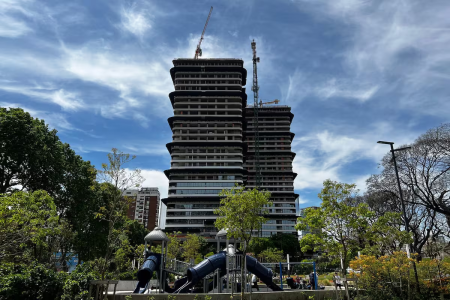
Over the past few years, more than 2,500,000 m² of construction was recorded annually, but the area actually completed was less than half.Daniel Basualdo
In most industries, it's very difficult to predict what will happen to supply. In construction , the opposite is true: because the production process takes years, the future can be predicted with considerable accuracy . And that prediction is uncomfortable today. Because while the market continues to focus on demand, the data shows that supply in the city of Buenos Aires has already begun to fall sharply and, more importantly, will continue to do so.
The most widely used indicator for predicting the future—building permits—is, in reality, misleading . Over 2,500,000 square meters of permits were registered annually in recent years , but the area actually completed was less than half that . Many projects are approved but never begin; others simply modify their permits, and the permit registry doubles the number. The real supply lies not in what is approved, but in what is actually built. And that's where the first problem arises.
In the first quarter of 2026, the area of newly built space fell by 40% compared to the previous year , according to preliminary data from the Government Control Agency. This is not an isolated event: the last quarter of 2025 had already seen a year-on-year decrease of 25%. The paradox is that this occurred after a record high. In 2025, more than 1,300,000 m² were delivered, the highest volume in the last six years . This enormous amount of product was largely the reason why prices remained relatively stable, even with high demand. Supply, once again, acted as the regulator.
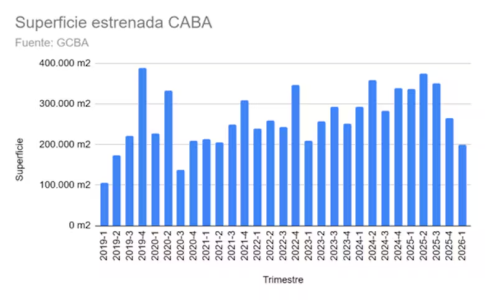
In the first quarter of 2026, the newly opened surface area shows a 40% drop compared to last yearGCBA
But that real estate boom wasn't accidental . Between 2019 and 2022, a combination of factors emerged that will be difficult to replicate: cheap land due to regulatory changes and very low construction costs in dollars. This context spurred a wave of developments that are now being completed and explain the recent peak in deliveries. The problem is that this cycle has already ended. Since 2023, construction costs have been rising steadily, and since 2024, land values have increased again. The result is immediate: fewer new projects and, therefore, less future supply . And here we find the most important piece of information of all, the one that is almost never discussed. Today in the City, there are approximately 2,800,000 m² with completed structures , progressing in masonry and finishing touches, which will be delivered in the next three years. Another 1,700,000 m² are progressing in the structural phase and will be completed in a slightly longer timeframe.
In the initial foundation stages, a clear decline is already evident: approximately 1,500,000 m², 15% less than previous levels . And further back, a mere 750,000 m² are marked as construction sites, ready to begin. The calculation is simple: what's coming won't be enough to replace what's being completed . The supply curve has already shifted. Even in an optimistic scenario, where the building permit process were to begin en masse today, construction timelines make it impossible to reverse this trend in the short term. The supply for the coming years is already defined.
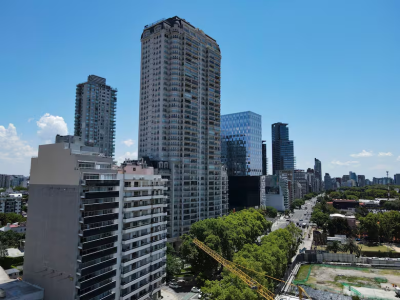
The neighborhoods that had gained prominence in recent years are beginning to lose ground to Palermo, Belgrano, or Núñez.Ricardo Pristupluk
The neighborhoods where the most construction is taking place
But the change isn't just in quantity. It's also in quality and location . With high construction costs, the relative weight of land in the business is reduced. This narrows the differences between neighborhoods and generates a fairly predictable trend: developers and investors stop taking risks and concentrate on established areas. The result is an increasingly marked " flight to quality ." Neighborhoods that had gained prominence in recent years —like Chacarita, Villa Ortúzar, Boedo, and Saavedra— are beginning to lose ground to Palermo, Belgrano, Núñez, Colegiales, and Caballito (along with Villa Urquiza, the neighborhoods with the highest population growth according to the latest census). The supply isn't just decreasing; it's also becoming more concentrated. In 2025, the five neighborhoods with the most newly built square meters accounted for 39% of the total. In the current initial stages, they already concentrate close to 50%. There are fewer projects, and in fewer locations. And increasingly farther from the south.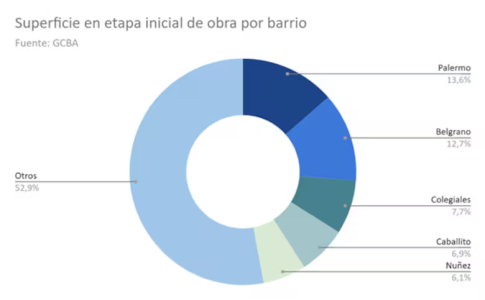
Area under construction in the initial stage by neighborhood: there are fewer construction projects, in fewer places, and increasingly further from the south GCBA
The question, then, is unavoidable. If supply falls and demand remains steady—or even increases—what happens to prices? Recent history offers a clue. In 2017, with delivery levels nearing 700,000 m² annually, the market experienced a clear supply strain that translated into price increases . Today, the process seems to be repeating itself, albeit with a difference: this time the adjustment is already underway, but it's not yet being felt by most. Because the market tends to react late.
First, less is built. Then the shortage is felt. And only then do prices start to rise. Supply has already shown its hand; everything is out in the open. Now we just have to see how demand will react and, consequently, how prices will change.
www.buysellba.com