Explore, connect, thrive in
the expat community

Expat Life: Local Discoveries, Global Connections

New wave of shutdowns and layoffs puts Argentine industry on alert

I went into Zara expecting cheaper prices. Here in the US it is known as a bargain priced store. I walked in there and same exact merchandise was very expensive. I thought prices were supposed to come down in Argentina but it didn't look like it. I went into many stores. It is hard to believe that locals would pay these prices. I noticed the same thing. No one is buying.
Stores like Zara are expensive compared to US or Europe. What I noticed is prices at higher quality stores is still very expensive. Stuff isn't selling but stores are discounting to get stuff out the door. As it should be.

 
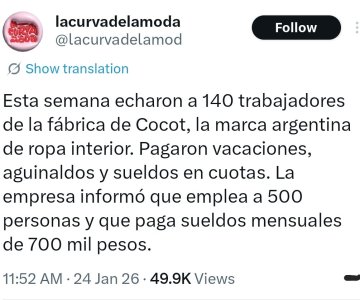
I keep reading about different manufacturing companies closing or laying off workers. I get that China produces stuff super cheap. But what I don't understand is how these Argentine companies can't compete? Everything I am reading seems to say salaries are only 700,000 pesos which is about $450 dollars per month. How can't these industries be competitive here. What gives?

G_dU1azW8AAccNd.jpeg
 
I keep reading about different manufacturing companies closing or laying off workers. I get that China produces stuff super cheap. But what I don't understand is how these Argentine companies can't compete? Everything I am reading seems to say salaries are only 700,000 pesos which is about $450 dollars per month. How can't these industries be competitive here. What gives?

View attachment 10275
That $450 bucks is what they are taking home but there is a sh*t ton of taxes in Argentina so the employer is paying at least double of what the employees are getting. At least if they are in white and not paying them under the table. Taxes and expenses eat up a big chunk and it is still cheaper in Asia.

Remember utility costs jumped up. Electricity jumped up 400%. Water and gas too. Labor is a small part of the equation. Many companies have to finance with huge interest %.

Argentine companies are lazy and had protectionist Peronist policies protecting them before. Labor was even cheaper and expenses were low. They can't compete with China period. They never had to before and they can't now and can't in the future. Argentina isn't an efficient country.

 
I keep reading about different manufacturing companies closing or laying off workers. I get that China produces stuff super cheap. But what I don't understand is how these Argentine companies can't compete? Everything I am reading seems to say salaries are only 700,000 pesos which is about $450 dollars per month. How can't these industries be competitive here. What gives?

View attachment 10275
I just watched a video of these employees at Cocoa getting fired. This is happening all over Argentina. Are there going to be enough replacement jobs for all of these people??? If so, where? What type of jobs.


I just watched a video of these employees at Cocoa getting fired. This is happening all over Argentina. Are there going to be enough replacement jobs for all of these people??? If so, where? What type of jobs.
15% of all factories in Argentina plan to reduce their staff at the beginning of 2026 due to the collapse in consumption by Argentines. According to INDEC, 52.3% of industrialists point out the "insufficiency of the internal market" as the great brake on production, in a context where 54.1% of factories admit to having orders "below normal" and an important part of the sector is already evaluating cutting working hours

 
15% of all factories in Argentina plan to reduce their staff at the beginning of 2026 due to the collapse in consumption by Argentines. According to INDEC, 52.3% of industrialists point out the "insufficiency of the internal market" as the great brake on production, in a context where 54.1% of factories admit to having orders "below normal" and an important part of the sector is already evaluating cutting working hours

I don't think there is anything wrong with a few thousand people suffering instead of the entire population overpaying for everything. These companies only survived with protection from the government. It should be a good lesson for Trump that it doesn't work. I'd love to see an argument between Trump and Milei with Milei schooling him on why this does not work.
 
I don't think there is anything wrong with a few thousand people suffering instead of the entire population overpaying for everything. These companies only survived with protection from the government. It should be a good lesson for Trump that it doesn't work. I'd love to see an argument between Trump and Milei with Milei schooling him on why this does not work.
Agree with this. It is one big reason why I think that Milei is safe. Not only is it wise to open up and lower costs on everything for the citizens but he is buying loyalty from the young voters that are getting many items shipped in from China at a fraction of the cost they were paying. This should only go down over time.

Once this happens you can't pivot back easily and roll these things back without riots. Even Peronists love buying clothes, shoes and games at a fraction of the cost. Shein stores are opening up with cheap Chinese clothes. It will be difficult to turn off the spigot of cheap Chinese goods.
 
I don't think there is anything wrong with a few thousand people suffering instead of the entire population overpaying for everything. These companies only survived with protection from the government. It should be a good lesson for Trump that it doesn't work. I'd love to see an argument between Trump and Milei with Milei schooling him on why this does not work.
All for the greater good and lower prices. Still, it is sad to see so many companies failing. Some of these companies have been around for over 100 years. My doorman's family all lost their jobs with this textile plant closing in Corrientes - Emilio Alal.

I can't see how plants like this or anything fabric related can do well against China. Not with electricity prices where they are now, still too high taxes, labor costs going up and overvalued exchange rate.

Also the consumption from locals has collapsed with spending falling. Dozens of companies are closing every day since Milei started. Probably will pick up as imports continue to go up.

Ceramics, textiles, appliances, metalworking. They are all shutting down.

 
I went into Zara expecting cheaper prices. Here in the US it is known as a bargain priced store. I walked in there and same exact merchandise was very expensive. I thought prices were supposed to come down in Argentina but it didn't look like it. I went into many stores. It is hard to believe that locals would pay these prices. I noticed the same thing. No one is buying.
Locals if they can't travel abroad many times are forced to pay these prices. This will change as imports open up. The question will be if prices come down in the stores or not. Many times stores would rather close than reduce their profit margins.
All for the greater good and lower prices. Still, it is sad to see so many companies failing. Some of these companies have been around for over 100 years. My doorman's family all lost their jobs with this textile plant closing in Corrientes - Emilio Alal.

I can't see how plants like this or anything fabric related can do well against China. Not with electricity prices where they are now, still too high taxes, labor costs going up and overvalued exchange rate.

Also the consumption from locals has collapsed with spending falling. Dozens of companies are closing every day since Milei started. Probably will pick up as imports continue to go up.

Ceramics, textiles, appliances, metalworking. They are all shutting down.

The problem is that these companies never invested any money in improvements with infrastructure or equipment. They just counted on crony protectionism from K's.
 
Locals if they can't travel abroad many times are forced to pay these prices. This will change as imports open up. The question will be if prices come down in the stores or not. Many times stores would rather close than reduce their profit margins.

The problem is that these companies never invested any money in improvements with infrastructure or equipment. They just counted on crony protectionism from K's.
They only have themselves to blame. They thought they would be protected forever. Most Argentine companies don't invest in upgrading their equipment or technology. They mistakenly assumed the government would protect them forever in an unfair advantage.

What I like about Milei is he is opening up Argentina. Usually they would just give contracts to friends and take a piece of it. That might still be happening but you can see he is giving contracts to foreign companies instead of Argentines which is a good start.


Archived
 
The problem with Argentina is totally unviable with the current tax burden and structure, labor costs and logistics expenses. It only works with an overvalued peso and high exchange rate. What we've seen in the past is the dollar will inevitably go up and then we repeat the cycles.
 

According to Gandini, it’s the first time “in Techint’s more than 70 years in the country”, that its steel company — the only local manufacturer of tubes for the oil and gas industry — has not been chosen for a major energy project.

Welspun also beat 13 other bids from companies in Spain, China, Colombia, Mexico, Japan, Greece, and Turkey, La Nación reported.

“The winning bid barely exceeded US$200 million and was 40% lower than Techint’s,” said journalist Pablo Fernández Blanco.
 
the question is how will Welspun source the steel for its pipe line?
They make a lot of steel pipes. They don't need to produce them in Argentina. They will just export them into Argentina and probably will get a tax exempt status to do it.

Or they can import hot rolled coil and just manufacture it in Argentina themselves. Or they can partner with a Brazilian company. With prices in Argentina being what they are it's doubtful they will source any steel from Argentina which is expensive now.

It's much cheaper to produce the pipes in India or China and then ship it to Argentina. With the overvalued peso that is going to be cheaper. On our projects my company works on in Brazil they source it from China and India which are the cheapest. Turkey is also competitive on price. Right now Latin American mills are more expensive. Hence the 40% lower bid.

Besides cost, Milei was most likely sending a signal to Argentine companies that their sugar rush protectionist days are over. It also is a sign to local companies that they are not competitive now and need to change their ways or they won't make it.

With the peso so strong imports are going to be much cheaper. Less trade barriers and as we are seeing with local consumption, the global market is going to change things.
 
“The winning bid barely exceeded US$200 million and was 40% lower than Techint’s,” said journalist Pablo Fernández Blanco.
Just goes to show you how uncompetitive local companies are. An eye opener. I was surprised my last visit to Buenos Aires a few months ago. I went to get a choripan and it was about $12 dollars with a water. Then we went to go get an ice cream and it was almost $9 dollars. Both places were almost empty.
 
Just goes to show you how uncompetitive local companies are. An eye opener. I was surprised my last visit to Buenos Aires a few months ago. I went to get a choripan and it was about $12 dollars with a water. Then we went to go get an ice cream and it was almost $9 dollars. Both places were almost empty.
Sounds like you ate over in Soho or Hollywood. You can still get a Choripan less expensive outside of touristy areas but costs have definitely gone up. Some of those prices they are trying to get are outrageous! You can get away with it when there are tons of tourists willing to overpay but I see a lot of places empty now.
 
Just goes to show you how uncompetitive local companies are. An eye opener. I was surprised my last visit to Buenos Aires a few months ago. I went to get a choripan and it was about $12 dollars with a water. Then we went to go get an ice cream and it was almost $9 dollars. Both places were almost empty.
Sounds like you went to Chori for the choripan.
 
All for the greater good and lower prices. Still, it is sad to see so many companies failing. Some of these companies have been around for over 100 years. My doorman's family all lost their jobs with this textile plant closing in Corrientes - Emilio Alal.

I can't see how plants like this or anything fabric related can do well against China. Not with electricity prices where they are now, still too high taxes, labor costs going up and overvalued exchange rate.

Also the consumption from locals has collapsed with spending falling. Dozens of companies are closing every day since Milei started. Probably will pick up as imports continue to go up.

Ceramics, textiles, appliances, metalworking. They are all shutting down.

Read about this in Clarin. I'm not sure how the government is to blame. Selling inferior quality at sky high prices is not a winning formula to stay in business.


I guess some of the people outside didn't think so either.

 
They make a lot of steel pipes. They don't need to produce them in Argentina. They will just export them into Argentina and probably will get a tax exempt status to do it.

Or they can import hot rolled coil and just manufacture it in Argentina themselves. Or they can partner with a Brazilian company. With prices in Argentina being what they are it's doubtful they will source any steel from Argentina which is expensive now.

It's much cheaper to produce the pipes in India or China and then ship it to Argentina. With the overvalued peso that is going to be cheaper. On our projects my company works on in Brazil they source it from China and India which are the cheapest. Turkey is also competitive on price. Right now Latin American mills are more expensive. Hence the 40% lower bid.

Besides cost, Milei was most likely sending a signal to Argentine companies that their sugar rush protectionist days are over. It also is a sign to local companies that they are not competitive now and need to change their ways or they won't make it.

With the peso so strong imports are going to be much cheaper. Less trade barriers and as we are seeing with local consumption, the global market is going to change things.
Indeed. Some businesses will restructure and find ways to compete, some will find themselves unable, and others will realize their business has no natural advantage in Argentina and closing is the only option. It is painful for companies and workers but it is great for consumers and taxpayers, and eventually capital and labor will get reallocated to better uses.

Traditional retail in Argentina will collapse overnight if Amazon is ever allowed to flourish there. I could not believe the prices of goods in Buenos Aires, there is no reason to buy anything if you can get it elsewhere.
 
Back
Top