

BuySellBA
Administrator
Mortgage loans: which banks lowered rates and what's the best option today between UVA and non-inflation-adjusted options - Ambito Financiero

Source:

Créditos hipotecarios: qué bancos bajaron las tasas y qué conviene hoy entre UVA y opciones sin ajuste por inflación
Se reconfigura la “guerra de tasas” entre bancos. Bajas recientes, crédito en movimiento y dudas sobre qué esquema conviene según ingresos.
 www.ambito.com
April 17, 2026
By Jose Luis Cieri
The "interest rate war" between banks is being reshaped. Recent rate cuts, shifting credit lines, and uncertainty about which plan is best for different income levels.

Mortgage credit lines are making a comeback with rates under review, while access to homeownership increasingly depends on the cost of financing and the evolution of inflation.
The mortgage market has seen renewed activity in recent weeks, signaling a clear shift: several banks have lowered their rates amid increased competition and improved macroeconomic conditions. While rates remain historically high, this change in trend has revived inquiries and transactions in the real estate sector.
The phenomenon is part of what operators and economists are already calling a new "rate war", with public and private entities seeking to position themselves to capture demand in a segment with high growth potential.
Banks that lowered rates and a new credit map
Recently, several financial institutions have seen price cuts. Among the most significant moves are reductions at banks such as Ciudad, BBVA, and Santander , which began adjusting their rates after a previous period of increases that had cooled the market.ICBC recently also significantly adjusted its offerings and launched one of the most competitive proposals on the market. The bank set a rate of 6.9% + UVA for those with direct deposit of their salary and 9.9% for everyone else. Furthermore, it expanded its terms: financing up to 80% of the loan value, with repayment periods of up to 20 years and the option to combine family income.
Today, interest rates on UVA-indexed loans vary widely. While some institutions still operate at around 15%, others are already positioned at more competitive levels. The most notable example is Banco Nación, which offers rates around 6% for clients who have their salary deposited directly into their accounts, making it the main driver of these financing transactions.
Further down the list are banks with rates close to 10% or 11%, while the most expensive still hover around 15%. This wide range forces buyers to compare rates in detail before making a decision.
Andrés Salinas , economist and professor at the University of La Matanza (Unlam), explained that part of the decline is due to a correction following a previous overreaction by the financial system.
He elaborated: “Going from 15% to 12.5% is still a high level. I don't think anyone chooses a bank based solely on a three-point difference in that range. There's some adjustment involved, and also some marketing to avoid being seen as the institution with the highest rate.”
In percentages
Following those that lowered rates, the current market range is between 6% (only Banco Nación for those who receive their salary through the entity) and 15%, with a downward trend driven by greater competition among banks.- Banco Nación: 6% + UVA.
- Banco Ciudad: from 7.5% + UVA, with increments of 9% to 9.5% depending on profile and area.
- BBVA: between 7.5% and 10.9% + UVA.
- Santander: 9.5% + UVA.
- ICBC: 6.9% + UVA for clients with salaries and 9.9% for the rest.
- Banco Patagonia: 12.5% + UVA.
- Galicia: 15% + UVA.
- Supervielle: 15% + UVA.
- Macro: 15% + UVA.
Downward trend, but with limits
The current scenario shows a downward trend, although still far from levels attractive to most buyers. The average system rate is currently around 11%, with variations depending on the client's profile and the bank.Salinas emphasized that the relevant data point is not the current level but the direction. He indicated that March marked the second consecutive month of declines in mortgage rates.

The cost of financing is back in the spotlight: small variations in rates have a direct impact on the installment and the purchase decision.
However, he cautioned that the improvement has limits. He noted that returning to conditions similar to those of previous years requires more profound changes in monetary policy.
Similarly, Federico González Rouco , an economist specializing in the real estate market and from Empiria Consultores, linked the rate cuts to a more stable macroeconomic context.
He explained that the reduction in country risk , less uncertainty, and the improvement in financial variables created conditions for banks to begin adjusting their products.
He also downplayed some specific announcements. González Rouco considered that specific policies, such as those of Banco Ciudad, have a limited impact in terms of volume, and stressed that what is relevant is the general trend of the system.
UVA vs variable rate: the underlying discussion
Beyond the dynamics of interest rates, the central debate remains which type of loan is best. The choice between UVA-indexed loans and loans without inflation adjustment remains relevant.UVA loans offer a clear advantage: the initial payment is significantly lower and more similar to rent. This makes them more accessible, especially for middle-income earners.
Salinas explained that, contrary to popular belief, UVA loans have a fixed interest rate. What varies is the principal in pesos, adjusted for inflation.
“With UVA-indexed loans, the initial payment is low. With non-UVA-indexed loans, the payment can be double from the start,” he explained.
In this context, the choice depends on expectations. Inflation, income, and financial outlook play a key role in the decision.
Oscar Puebla , architect and head of Puebla Inmobiliaria, argued that the analysis should focus on the evolution of macro variables.
He indicated that the UVA better reflects the behavior of inflation over time and allows for projecting a scheme more aligned with the economic context.
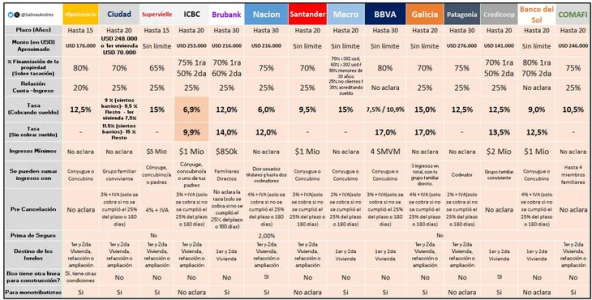
Source: Andrés Salinas, economist and professor at the University of La Matanza (Unlam)
He also suggested that there are specific profiles where other alternatives may be attractive, such as those who have income in dollars or seek to avoid any type of indexation.
The lines without UVA: Provincia and Credicoop
Alongside the UVA system, some institutions offer traditional loans without inflation adjustments. Banco Provincia and Banco Credicoop are among them.Banco Provincia offers an initial variable rate of 39.17%, calculated based on a fixed-term deposit plus four percentage points. It does not adjust for inflation, but the monthly payment varies depending on how the rate changes.
Credicoop, for its part, offers an initial rate of 38.41%, linked to the Badlar rate plus an additional amount. In this case, the rate is reviewed every four months.
While these lines eliminate the direct inflationary risk, they shift the uncertainty to the financial cost.
González Rouco was critical of these options. He considered them expensive and uncompetitive compared to UVA-rated products.
Similarly, Darío Rizzo , CEO of Alternativa Propiedades, pointed out that these alternatives target a very specific profile.
He indicated that the initial payment is several times higher than in UVA loans, which requires high income to qualify.
“For most buyers, UVA loans remain more convenient. These lines of credit are for those who prioritize predictability and don't want indexation,” Rizzo explained.
What to look for before taking out a loan
In a market with a high dispersion of rates and conditions, prior analysis is crucial.Rizzo emphasized that the focus should be on the annual effective rate (AER), which reflects the true cost of financing. He warned that the nominal rate can be misleading if other components are not taken into account.
He also recommended comparing different banks. He pointed out that the difference in the monthly payment for the same property can be significant depending on the bank and the client's profile.

A family analyzes mortgage options in front of a computer, with interest rates as the key variable that defines access to homeownership.
Another key factor is the evolution of inflation. If the downward trend continues, UVA loans become more attractive due to their lower initial cost.
In the real estate sector, credit is once again emerging as a driver of demand. Access to financing expands the pool of potential buyers and invigorates the market.
Rizzo concluded that the market will continue to show gradual adjustments and that opportunities will depend on each buyer's ability to analyze the conditions in detail and choose the most suitable credit.
www.buysellba.com