Explore, connect, thrive in
the expat community

Expat Life: Local Discoveries, Global Connections

How Expats Protect Their Money From Argentina’s Inflation

Actually the peso has been holding up strong. A lot of carry trade. My wife's family in their businesses keep a lot in pesos the past year. Getting about 30% interest rates! Can you imagine that in the USA!
Good article Jerry. Rule of thumb for most expats in Argentina has always been to just hold dollars. Sometimes the peso has moments of strength but if you look at the inflation over the past 25 years it always has made sense to hold USD.

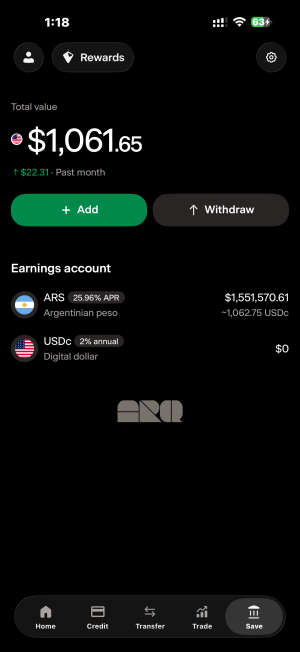
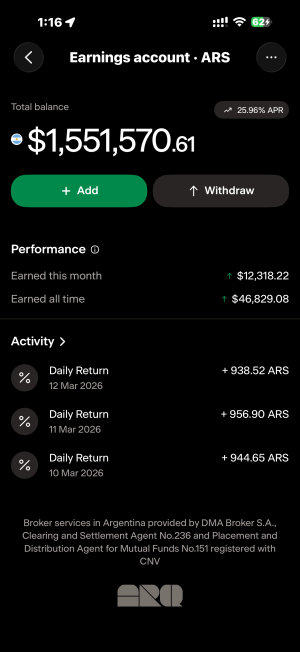
I only keep some pesos in an account to pay bills or when I'm trying a new App to see functionality. Here is the ARQ Dollar App. You can see the peso interest at 25.96%. 🤣

IMG_2474.PNG

IMG_2473.PNG
 
Good article Jerry. Rule of thumb for most expats in Argentina has always been to just hold dollars. Sometimes the peso has moments of strength but if you look at the inflation over the past 25 years it always has made sense to hold USD.

I only keep some pesos in an account to pay bills or when I'm trying a new App to see functionality. Here is the ARQ Dollar App. You can see the peso interest at 25.96%. 🤣

View attachment 10589

View attachment 10590
Back during Macri several of my friends had their savings in some plazo fijos (fixed term deposit) accounts. It was around the same interest rates. Close to 30%. You know when a bank is offering you 30% annual interest it's too good to be true.

Believe it or not when the government was desperate they goosed up the internet rates to 60%- 75% if I remember right. Some of my friends sold their dollars and bought pesos to put them into these plazo fijo accounts. You had to lock in for 30 days at a time. So they would get the interest and then buy back dollars.

This works as long as there is no sudden shocks. In August 2019 during the primary elections the market panicked at the results and peso value totally collapsed overnight. It went from 45 to $1 USD to 60 pesos in 2 hours. It devalued by 30% suddenly. My friend was locked into one of these 30 day fixed term deposits and even though she was making 60% APR that was only 5% a month.

So I think of them and just keep my money in dollars.
 
Good article Jerry. Rule of thumb for most expats in Argentina has always been to just hold dollars. Sometimes the peso has moments of strength but if you look at the inflation over the past 25 years it always has made sense to hold USD.

I only keep some pesos in an account to pay bills or when I'm trying a new App to see functionality. Here is the ARQ Dollar App. You can see the peso interest at 25.96%. 🤣

View attachment 10589

View attachment 10590
Thanks for the kind words!
 
Back during Macri several of my friends had their savings in some plazo fijos (fixed term deposit) accounts. It was around the same interest rates. Close to 30%. You know when a bank is offering you 30% annual interest it's too good to be true.

Believe it or not when the government was desperate they goosed up the internet rates to 60%- 75% if I remember right. Some of my friends sold their dollars and bought pesos to put them into these plazo fijo accounts. You had to lock in for 30 days at a time. So they would get the interest and then buy back dollars.

This works as long as there is no sudden shocks. In August 2019 during the primary elections the market panicked at the results and peso value totally collapsed overnight. It went from 45 to $1 USD to 60 pesos in 2 hours. It devalued by 30% suddenly. My friend was locked into one of these 30 day fixed term deposits and even though she was making 60% APR that was only 5% a month.

So I think of them and just keep my money in dollars.
Agree safer to keep them in dollars. We have a peso account just to pay bills.

It wasn't just banks that squeezed consumers when there was a massive devaluation.

A few times in Argentina's history when people lost out. The fact that Caputo doesn't keep his money in Argentine banks says enough. He keeps all his dollars in the USA and outside of Argentina.

Because plazo fijos, many middle-class Argentines kept their money in liquid mutual funds - Fondos Comunes de Inversión - offered by their banks. I know many such people.

In late 2019, the government ran out of money and unilaterally delayed the payment of its own short-term peso bonds. A move they politely called a reperfilamiento (reprofiling). Because the mutual funds were heavily invested in these government bonds, the funds were suddenly frozen. Regular people found themselves unable to access their daily cash for several days or weeks until the government untangled the mess. So you just have to be careful here.

@Betsy Ross I have a friend here that I warned against the 30 day plazo fijo. He also lost out during that time. When the 30 day period came and he wanted to get his pesos out, the government had to prevent all of the people from withdrawing. That is when they re-implemented severe currency controls and the Cepo started.

This is why people are in no hurry to deposit their cash in the banks. All my friends that tried to withdraw their pesos after their 30 day period matured, the banks/government restricted them from buying dollars. Started out as $10,000 USD but then just $200 USD per month.

So my friends had devalued pesos and NO legal way to convert them back into hard currency. The same thing could (and probably will) eventually happen again.

 
Good article Jerry. Rule of thumb for most expats in Argentina has always been to just hold dollars. Sometimes the peso has moments of strength but if you look at the inflation over the past 25 years it always has made sense to hold USD.

I only keep some pesos in an account to pay bills or when I'm trying a new App to see functionality. Here is the ARQ Dollar App. You can see the peso interest at 25.96%. 🤣

View attachment 10589

View attachment 10590
Any time someone promises a return like that it is typically a Ponzi scheme. I am not sure how this is sustainable for the government and banks to pay 30% interest rates. And that is even with rates coming down. The bicycle finance sounds like it is still in full swing.

Agree safer to keep them in dollars. We have a peso account just to pay bills.

It wasn't just banks that squeezed consumers when there was a massive devaluation.

A few times in Argentina's history when people lost out. The fact that Caputo doesn't keep his money in Argentine banks says enough. He keeps all his dollars in the USA and outside of Argentina.

Because plazo fijos, many middle-class Argentines kept their money in liquid mutual funds - Fondos Comunes de Inversión - offered by their banks. I know many such people.

In late 2019, the government ran out of money and unilaterally delayed the payment of its own short-term peso bonds. A move they politely called a reperfilamiento (reprofiling). Because the mutual funds were heavily invested in these government bonds, the funds were suddenly frozen. Regular people found themselves unable to access their daily cash for several days or weeks until the government untangled the mess. So you just have to be careful here.

@Betsy Ross I have a friend here that I warned against the 30 day plazo fijo. He also lost out during that time. When the 30 day period came and he wanted to get his pesos out, the government had to prevent all of the people from withdrawing. That is when they re-implemented severe currency controls and the Cepo started.

This is why people are in no hurry to deposit their cash in the banks. All my friends that tried to withdraw their pesos after their 30 day period matured, the banks/government restricted them from buying dollars. Started out as $10,000 USD but then just $200 USD per month.

So my friends had devalued pesos and NO legal way to convert them back into hard currency. The same thing could (and probably will) eventually happen again.
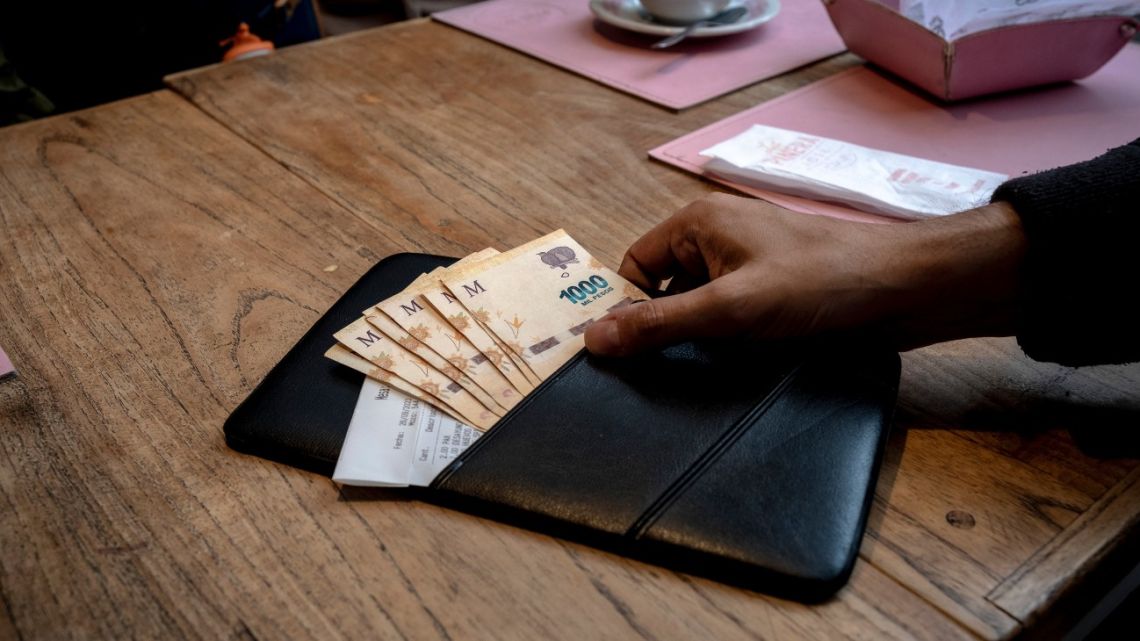
Thank you for sharing this story. People forget these kind of stories and the history of the government. And from watching things from the sidelines, things can change VERY quickly in Argentina. This younger generation probably has no idea of these types of things. They might trust the government but I doubt their parents or grandparents will.
 
Back during Macri several of my friends had their savings in some plazo fijos (fixed term deposit) accounts. It was around the same interest rates. Close to 30%. You know when a bank is offering you 30% annual interest it's too good to be true.

Believe it or not when the government was desperate they goosed up the internet rates to 60%- 75% if I remember right. Some of my friends sold their dollars and bought pesos to put them into these plazo fijo accounts. You had to lock in for 30 days at a time. So they would get the interest and then buy back dollars.

This works as long as there is no sudden shocks. In August 2019 during the primary elections the market panicked at the results and peso value totally collapsed overnight. It went from 45 to $1 USD to 60 pesos in 2 hours. It devalued by 30% suddenly. My friend was locked into one of these 30 day fixed term deposits and even though she was making 60% APR that was only 5% a month.

So I think of them and just keep my money in dollars.
Very helpful to read these kind of stories. Seeing interest rates of 60% a year is just insane. But I guess it is nothing if it plummets suddenly.

Agree safer to keep them in dollars. We have a peso account just to pay bills.

It wasn't just banks that squeezed consumers when there was a massive devaluation.

A few times in Argentina's history when people lost out. The fact that Caputo doesn't keep his money in Argentine banks says enough. He keeps all his dollars in the USA and outside of Argentina.

Because plazo fijos, many middle-class Argentines kept their money in liquid mutual funds - Fondos Comunes de Inversión - offered by their banks. I know many such people.

In late 2019, the government ran out of money and unilaterally delayed the payment of its own short-term peso bonds. A move they politely called a reperfilamiento (reprofiling). Because the mutual funds were heavily invested in these government bonds, the funds were suddenly frozen. Regular people found themselves unable to access their daily cash for several days or weeks until the government untangled the mess. So you just have to be careful here.

@Betsy Ross I have a friend here that I warned against the 30 day plazo fijo. He also lost out during that time. When the 30 day period came and he wanted to get his pesos out, the government had to prevent all of the people from withdrawing. That is when they re-implemented severe currency controls and the Cepo started.

This is why people are in no hurry to deposit their cash in the banks. All my friends that tried to withdraw their pesos after their 30 day period matured, the banks/government restricted them from buying dollars. Started out as $10,000 USD but then just $200 USD per month.

So my friends had devalued pesos and NO legal way to convert them back into hard currency. The same thing could (and probably will) eventually happen again.
Thanks for explaining this. I guess this is why the author of the Bitcoin Standard is so critical of what Milei is doing. I didn't understand it too well but I understand more after reading your post Nasdaq. Thank you.

 
He is correct. There is no economic miracle. There is no plan in place. Recession recession. Places are closing. Only bicycle finance which eventually ends up crashing. Always the same.
But Milei promised us 0% inflation by middle of 2026.

 
Agree safer to keep them in dollars. We have a peso account just to pay bills.

It wasn't just banks that squeezed consumers when there was a massive devaluation.

A few times in Argentina's history when people lost out. The fact that Caputo doesn't keep his money in Argentine banks says enough. He keeps all his dollars in the USA and outside of Argentina.

Because plazo fijos, many middle-class Argentines kept their money in liquid mutual funds - Fondos Comunes de Inversión - offered by their banks. I know many such people.

In late 2019, the government ran out of money and unilaterally delayed the payment of its own short-term peso bonds. A move they politely called a reperfilamiento (reprofiling). Because the mutual funds were heavily invested in these government bonds, the funds were suddenly frozen. Regular people found themselves unable to access their daily cash for several days or weeks until the government untangled the mess. So you just have to be careful here.

@Betsy Ross I have a friend here that I warned against the 30 day plazo fijo. He also lost out during that time. When the 30 day period came and he wanted to get his pesos out, the government had to prevent all of the people from withdrawing. That is when they re-implemented severe currency controls and the Cepo started.

This is why people are in no hurry to deposit their cash in the banks. All my friends that tried to withdraw their pesos after their 30 day period matured, the banks/government restricted them from buying dollars. Started out as $10,000 USD but then just $200 USD per month.

So my friends had devalued pesos and NO legal way to convert them back into hard currency. The same thing could (and probably will) eventually happen again.
This isn't even the half of it. Why do you think Caputo and all the rest of the cabinet won't bring their cash into Argentina. The right hand doesn't know what the left hand is doing here.

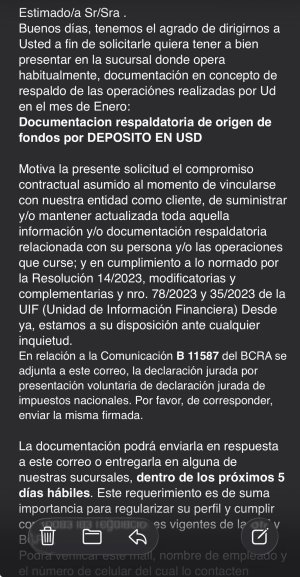
Milei is telling everyone to bring their cash to Banco la Nacion and to deposit their dollars and cash. My friend did and she is stuck in a mountain of paperwork. She deposited her money and then a few days after she gets this notice. This is cash she saved for 10 years. And people are supposed to trust the banks and government. No thanks.

arca.jpeg
 
This isn't even the half of it. Why do you think Caputo and all the rest of the cabinet won't bring their cash into Argentina. The right hand doesn't know what the left hand is doing here.

Milei is telling everyone to bring their cash to Banco la Nacion and to deposit their dollars and cash. My friend did and she is stuck in a mountain of paperwork. She deposited her money and then a few days after she gets this notice. This is cash she saved for 10 years. And people are supposed to trust the banks and government. No thanks.

View attachment 10593
Only a fool would trust an Argentine bank. Problem after problem. Even today.
 
Back
Top