

BuySellBA
Administrator
Contradictory data: more properties were sold in March, but mortgage lending fell; how can this be explained? - La Nacion Propiedades

Source:
April 23, 2026
The real estate market is experiencing a contrasting dynamic that surprised even Marcos Galperin, founder of Mercado Libre.
By Candela Contreras
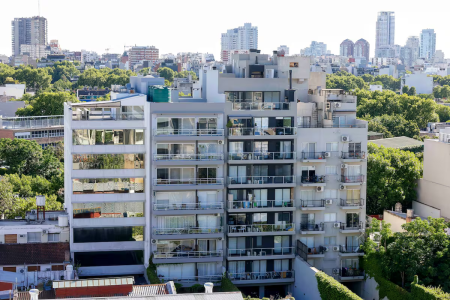
In the third month of the year, 5,590 deeds of sale were signed, 17.8% more than in March 2025. Santiago Filipuzzi
After a weak start to the year , in which the real estate market fully felt the increase in mortgage interest rates - from the second half of 2025 - March took a turn that surprised even the players in the sector.
According to the College of Notaries of the City of Buenos Aires, in the third month of the year 5590 deeds of sale were signed , 17.8% more than in March 2025 and a jump of 56.7% compared to February (3567 deeds).
The seemingly positive figure has nuances. The growth breaks a four-month streak of declines and positions March as the sixth-best historical record for that month, although still far from the levels of 2018 , at the height of the UVA loan boom.
Even Marcos Galperin , the founder of Mercado Libre , was surprised by the data and posted on his social media account: “In March, 18% more properties were registered than last year, making it the second-best March in the last 10 years... This is a very strange recession.” President Javier Milei reposted his post .
Furthermore, it's important to clarify that January and February are seasonal months in which the number of sales transactions tends to decrease , regardless of the year. However, the striking fact is that despite the increase in transactions, the mortgage lending situation did not follow suit . This demonstrates that the year-on-year increase in property purchases was primarily driven by people who had their own capital—cash .
In numbers, the total amount traded reached $902.972 billion , representing a 46% year-on-year increase . On average, each transaction was valued at $161.5 million , equivalent to US$113,802 , which implies a 4.1% decrease in dollar terms . In other words, more properties are being sold, but at lower prices in foreign currency . Market sources indicate that transactions are occurring at two speeds: lower-priced properties are being acquired through mortgage loans, while higher-priced properties are being purchased with cash .

March's growth cuts a four-month streak of consecutive declinesShutterstock - Shutterstock
The fall in mortgage lending
The data point that raises concerns about mortgages . In March, 834 mortgage deeds were registered , representing a 15.9% year-on-year decrease, but an increase compared to the previous month (when 592 were formalized). Currently, mortgages account for only 14.9% of all transactions , and this is expected to remain the case in the coming months. However, the positive aspect is that the decline was not as severe as in previous periods.That's where the "contradiction" arises : the market is growing in volume, but without the main engine that historically fuels its growth . "The good news is that, while credit has decreased, it hasn't collapsed like in other years when it dried up," sources in the sector say.
“ We’ve recovered year-on-year growth after four months of some declines . Now we need to see how credit develops ,” summarized Magdalena Tato, president of the Notaries Association. She added a key point: “ Credit not only drives transactions, it also facilitates access to housing . It’s encouraging that some banks have lowered rates, but there’s still much to be done in that area.”
The impact is significant. Industry experts estimate that each mortgage generates up to 2.5 additional transactions. Without this spillover effect, growth is limited . Therefore , the recent decrease in loan rates —starting at the beginning of this year— offers some relief to the mortgage sector , which the market expects to see reflected in the coming months.
The historical comparison clearly shows the change in the landscape. In March 2018 (at the height of the UVA mortgage boom), more than 2,200 mortgages had been registered, 166% more than today. This surge explains the peaks in activity at that time.
Today, however, the market is driven more by buyers with liquidity or access to their own dollars . According to Soledad Balayán, head of Maure Inmobiliaria, this reflects a perception of opportunity: “There is a segment that understands that properties are well-priced and is willing to buy.”
The exchange rate plays a silent but decisive role . A stable or even appreciated dollar tends to improve purchasing power in real terms. However, this effect is not enough to replace credit.
Dan Obetko, premium residential manager at Interwin, confirms this trend and states that they are seeing a higher level of inquiries than last year. “ Since prices are stable, deals are closing . Properties that are well-appraised, well-located, and listed at prices that the market accepts receive a good level of inquiries and reservations,” he affirms.
So, was March a rebound or a trend?
There is a consensus within the sector that the March data should be interpreted with caution . For Fabián Achával, economist and head of the eponymous real estate company, the jump is more a carryover effect than a structural change: “ It’s a month of recovering transactions that didn’t happen in January and February. The market is normalizing somewhat after a poor first two months .”The beginning of 2026 was atypical: the first two months showed a decline in activity without the classic trigger of a currency or electoral crisis. This may have generated pent-up demand that finally surged in March .
Furthermore, another relevant piece of data emerges: the average purchase price in dollars continues to decline , suggesting that the market is shifting towards lower-value properties or those with greater negotiating power. However, the data on the decline in credit does not support this.
The first quarter closes with a “technical tie” with 2025 , with approximately 12,500 accumulated transactions . But the true reflection of the market will come in the following months: from April onward, the year-on-year comparison will be against a period with a higher volume of loans. “ This is good news that provides reassurance that the year didn't start badly ,” Achával adds.
In this context, interest rate behavior will be key . Some institutions have begun to cut rates, but the system is still far from consolidating a robust supply.
The market , for now, presents an ambiguous picture: more deeds being registered, but with less credit available ; more activity, but with lower transaction values . The market's true direction will be determined in the coming months; April, in particular, will show whether the March figures reflect only transactions carried over from the first two months of the year or a more pronounced market realignment.
What happened in the province of Buenos Aires
Similar to what happened in the city of Buenos Aires, in the Province there was also an increase in deeds both year-on-year and month-on-month , although in this case the increase was less significant.
In March, 11,116 real estate transactions were registered , 45% more than in February (7,655) , according to the monthly survey conducted by the Buenos Aires Notary Association. Year-on-year, the increase was 8% compared to the same month in 2015 , when 10,317 transactions were completed. It was also noted that March was the best month for real estate transactions since 2018 .
In the case of mortgage transactions, the situation was also similar to that of the City of Buenos Aires. In March there were 1,509 transactions, 10% fewer than in March 2025. Compared to February, however, there was a 44% increase.
“The numbers for this first quarter are positive, but market behavior in different months doesn't yet allow us to see what the annual trend will be,” analyzed Guillermo Longhi, president of the association. He added, “It's important to emphasize that for the upward trend to solidify, it's essential to stimulate the mortgage market.”
But the market interprets it differently. “It’s important to point out that despite the increase in March, we’re still 25% below the volume traded in 2018,” stated Maximiliano D’Aria, director of D’Aria Propiedades, and illustrated his point: “That year, with the dollar at $20.30, approximately US$1.1 billion was traded; while this March, with the number of deeds practically the same, the volume traded only reached US$790 million (with the dollar at $1400).” In other words, the quantity increased, but not the volume.
To that diagnosis, he adds another structural factor: the deed registration statistics only show a portion of the market . “The other important analysis is that only a sample of the deeded units is being considered, which are the ones that are registered and for which data exists. New developments or units under construction are very significant in the real estate market , where an estimated 25,000 to 30,000 units are sold annually,” explained D'Aria. In that sense, he made a clear distinction : “What has definitely been reactivated is the used property segment (those with deeds), as seen in March 2026, but the same reactivation is not being seen in the new construction market, where absorption is slower . ”
www.buysellba.com