

BuySellBA
Administrator
The phenomenon in gated communities that surprised real estate investors - La Nacion Propiedades

Source:

El fenómeno en los barrios cerrados que sorprendió a los inversores inmobiliarios
Un sector de la clase media de ingresos altos comenzó a mover el mercado de alquiler de los barrios cerrados en Buenos Aires con contratos de largo plazo: cuánto cuestan
 www.lanacion.com.ar
April 06, 2026
A segment of the upper-middle class has begun to drive the rental market in gated communities in Buenos Aires with long-term contracts: how much do they cost?
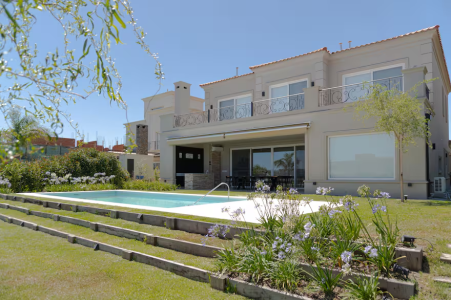
Rentals in gated communities are growing strongly, especially in Pilar and Tigre.Luciana Mata
For years, gated communities were synonymous with homeownership : your own lot, a house to your liking, and a move that could be considered "forever." But in recent years, that phenomenon has begun to change . Moreover, one of the fastest-growing residential trends, especially since 2020, involves renting homes in these developments .
Not only has the number of residents and developments grown, but a nascent rental market has also begun to solidify, attracting a segment of the upper-middle class who prioritize security, services, and quality of life over ownership itself. This fact is no longer surprising: living in a gated community without owning a property is part of the new real estate landscape .
According to a report by Tejido Urbano released a few days ago, rentals in gated communities are growing strongly , especially in Pilar and Tigre , attracting both single-person households and families. The logic is clear: for many, renting in the suburbs is cost-competitive with renting in established Buenos Aires neighborhoods like Palermo. Housing , more than an asset, has become an experience adaptable to each stage of life .
What motivates the upper middle class to rent in gated communities?
According to the survey, the growth in rentals in gated communities is due to a combination of the search for well-being, social distinction, and wealth-building strategies . It 's no longer just about "not being able to buy," but about choosing how and where to live. Among the most common strategies are tenant-owners (owners of a home in the city who rent it out to finance their suburban residence), satellite homes to support their work life in Buenos Aires, and the use of rentals as a second home for weekends or seasonal stays.The primary motivation is access to a controlled urban environment : security, services, green spaces, and tranquility. For families with young children and elderly relatives, this combination is hard to match in the traditional city. But there's more. For a segment of the upper middle class that has fallen outside the realm of homeownership in these areas , renting serves as a mechanism for social distinction . Living in a gated community maintains a high symbolic status, even without owning property .
The report also identifies a direct link between rent and productivity . In municipalities with dynamic industrial hubs like Pilar, Ezeiza, and Tigre, there is a growing demand for single-person or short-term rentals, occupied by skilled technicians and professionals who choose to live close to work. Less time spent on the Pan-American Highway means more productive hours.
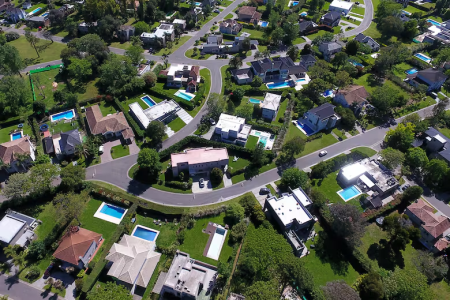
The growth in rentals in gated communities is due to a combination of the search for well-being, social distinction, and wealth strategies.RICARDO PRISTUPLUK
Rents in gated communities in numbers
According to the metadata of the Gated Community Map compiled by Pablo De Grande (2022), gated communities in Argentina occupy a total area of 700,467 km². Of this total, the province of Buenos Aires accounts for 527,777 km² (75%), while the Buenos Aires Metropolitan Region (RMBA) and its surrounding areas cover 485,543 km², equivalent to 69% of the national total and 92% of the provincial total. This confirms that the phenomenon of gated communities is strongly associated with the metropolitan dynamics of Buenos Aires .Within this region, 767 areas corresponding to gated communities have been identified . Of these, one in ten is located in the municipality of Pilar , which tops the ranking with a cumulative area of 76.372 km². It is followed, albeit at a considerable distance, by Tigre (47.607 km²), Luján (37.816 km²), Escobar (34.914 km²), Brandsen (31.041 km²), and Zárate (30.246 km²). The municipalities of Ezeiza, General Rodríguez, Cañuelas, and San Vicente complete the top ten, with areas ranging between 15 and 20 km².
Now, when distinguishing between registered tenants in gated communities, census tracts that include these neighborhoods contain approximately 170,000 households , of which between 12.5% and 15.5% are tenants . And with one key characteristic: access barriers remain high. Contracts in dollars, demanding guarantees, and high maintenance fees act as filters that moderate expansion, even as prices tend to adjust downward to avoid vacant properties.
Nordelta, a special case
It's important to clarify that Nordelta clearly leads the ranking of neighborhoods in terms of area, with 17.17 km² , more than a third of all developments located in Tigre. On its own, it would rank among the top 10 municipalities , surpassing the combined area of projects located in Ezeiza, General Rodríguez, Cañuelas, and San Vicente. Similar situations can be observed with Puertos (14.24 km²) and Complejo San Sebastián (9.63 km²), in Pilar.There, renting represents a key statistic : it accounts for 27.5% of households , well above the regional average. An estimated 1,911 households are renters out of a total of 6,971 . This internal distribution is not accidental. Renters are concentrated along main thoroughfares and edges, such as Avenida de los Colegios or Avenida del Puerto, while central neighborhoods like La Isla, Virazón, Los Castores, or El Golf maintain an almost exclusively owner-occupied profile.
“The spatial structure appears to follow a concentric logic: a core owner in the central areas and peripheral rings of tenants towards the edges,” the report explains.
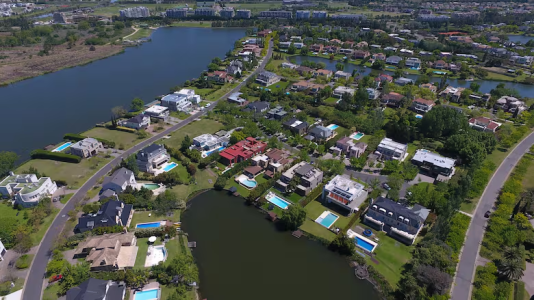
Nordelta leads the ranking of neighborhood surface area with 17.17 km²RICARDO PRISTUPLUK
Nordelta vs Palermo
The comparison with Palermo helps to put the phenomenon into perspective . Before the pandemic, renting in Nordelta was between 15% and 25% cheaper than in the Buenos Aires neighborhood . During 2021, driven by the lockdown, Nordelta became 35% more expensive. The post-pandemic period brought equilibrium. As of December 2025— the latest data available—a one-bedroom apartment averaged $804,193 in Nordelta compared to $831,201 in Palermo , according to Zonaprop.The difference lies not only in the price, but also in the risk. In Nordelta, dollar-denominated contracts predominate : attractive with exchange rate stability, risky with volatility. In Palermo, peso-denominated contracts and a more predictable cost structure continue to be the dominant factors. The result is a market more sensitive to macroeconomic fluctuations , especially for tenants who depend on their active employment income.
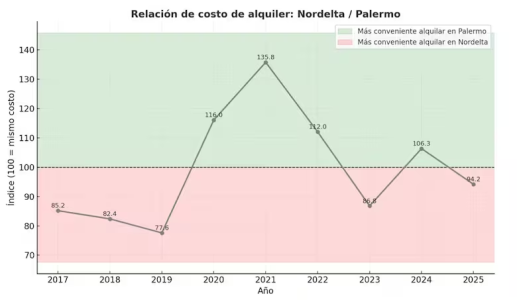
The current trend shows similar numbers between renting in Nordelta or Palermo.
The report shows that more mobile households (professionals and young families) adapt quickly to economic changes : they reduce their living space, change their housing type, or move. In contrast, older adults exhibit greater stability : their decisions are less influenced by the economic cycle and more by wealth and well-being strategies.
How much does it cost to rent in gated communities where demand is growing the most?
The territorial distribution shows that three municipalities in the northern corridor concentrate the majority of the tenant population in gated communities:- Tigre: leads the ranking with 6100 households (15,251 people).
- Pilar: ranks second with 4504 households (10,714 people).
- Escobar: registers 1963 households (5144 people)
The second epicenter appears in Bancalari , with developments like Windbells, Greenlands, and Ayres Chico. There, the supply is scarce . At the time of the survey, only a few specific listings were recorded: a four-bedroom house of 184 m² offered at US$5,000 , and an apartment in Ayres Chico listed at $1.6 million per month .
To a lesser extent, rental properties are also present in the Barrio Santa Clara, Barrio San Gabriel, Barrio San Andrés, and Club Newman developments in Benavídez. These projects, in particular, have a higher proportion of complete nuclear families, unlike Nordelta, where single-person households predominate . In these cases, renting a home starts at US$1,200 for a two-bedroom, 80 m² house and reaches up to US$4,000 for a four-bedroom, 800 m² property.
In the municipality of Pilar, another significant cluster of properties is located around the Haras del Pilar, Boulevard El Sol, La Madrugada, Champagnat, and Hábitat Residencias developments. In these areas, renting a home starts at US$2,200 for a 260 m² house with three bedrooms.
In contrast, in more traditional neighborhoods such as Sociedad Hebraica Pilar, Los Lagartos, La Martinica or Carmel Country Club, prices are usually between US$1200 and US$3500 , but there are higher options that reach up to US$5000 for 10-room units.
In the southern part of Greater Buenos Aires (AMBA) , rentals in gated communities are also gaining ground. In Nuevo Quilmes, prices average US$1200 , while in Finca Iraola (Berazategui) and Las Casuarinas (Ezeiza), rents start around US$1900 and can reach US$2600, with demand primarily from families seeking tranquility and green spaces.
In conclusion, the evidence shows that rentals in gated communities constitute an emerging segment of the housing market, distinct from traditional urban rentals. Its growth combines productive, heritage, and symbolic factors, revealing how the upper middle class is redefining ways of living between the city and the suburbs.
This expansion of the rental market also reflects a new form of differentiation within the middle class . For a segment unable to afford homeownership, living in a gated community becomes a sign of distinction, a way to maintain a certain symbolic status despite the loss of the homeownership horizon. Paradoxically, these are the same households that, given their income level, could qualify for mortgages; therefore, when financing becomes available again, many shift towards buying, leaving vacancies that the market then tries to fill.
www.buysellba.com