

BuySellBA
Administrator
The 5 mental blocks that can make you miss the opportunity to sell your house - La Nacion Propiedades

Source:

Las 5 trabas mentales que pueden hacer que pierdas la oportunidad de vender tu casa
Desde el miedo a vender barato hasta el sentido de pertenencia que generan los momentos vividos en cada ambiente
 www.lanacion.com.ar
April 10, 2026
From the fear of selling cheap to the sense of belonging generated by the moments lived in each environment
By Soledad Balayan

Biases are frequently observed in real estate market decision-making.Fernando de la Orden/NEWMARK
The behavior of the real estate market can be explained quite well using supply and demand . However, the individual behavior of real estate players is deeply influenced by cognitive biases resulting from mental shortcuts that help simplify reality, but which sometimes distort decision-making.
A cognitive bias is a systematic pattern in our thinking , a product of the brain's mechanisms for processing complex information. These shortcuts allow us to interpret the world quickly, but they also lead us to make mistakes. Personal experiences, culture, childhood lessons, our relationships, and beliefs accumulated over time shape these biases, some of which are particularly evident in the dynamics of the real estate market.
Let's look at some of the biases that are most frequently observed in the decision-making that drives the real estate market.
1-Loss aversion: driven by the fear of “selling badly”
Loss aversion describes the human tendency to feel the pain of a loss more intensely than the satisfaction of gaining an equivalent amount. Studies by psychologists Daniel Kahneman and Amos Tversky show that a loss hurts approximately twice as much as a gain of the same magnitude brings . This tendency, which we exhibit in contexts of uncertainty, leads us to focus more on what we might lose and less on the opportunities we might seize.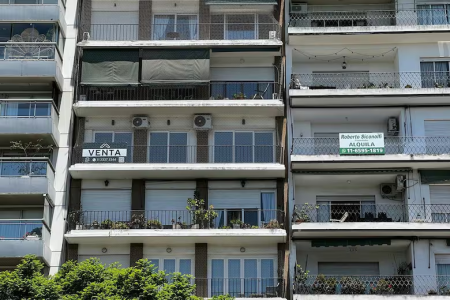
Many owners prefer not to sell rather than accept a price perceived as low.Daniel Basualdo
In the real estate market, this bias explains why many owners prefer not to sell rather than accept a perceived low price , even when the market has changed and they could use the proceeds to obtain, for example, a better return on other investments. The fear of "losing" compared to a past benchmark value often leads to prolonged delays, listings that don't reflect actual demand, and, paradoxically, higher costs over time.
2-Anchorage: the weight of the first number
Anchoring bias is one of the most common in the real estate market. It consists of giving excessive weight to the first piece of information available when estimating a value , during negotiations, or, for example, the initial purchase price of the property. What often happens is that this "anchor" becomes the benchmark against which we measure losses or gains.The original purchase price, a historical neighborhood value, or even a suggested price without technical justification, often becomes an emotional anchor. Even if the market context has changed, that initial figure shapes the perception of value and hinders the adjustments needed to finalize a transaction without incorporating the current market situation into the analysis. It's very common for owners to cling to average prices per square meter based on reports from real estate portals that are regularly published—figures derived from listed prices that don't take into account closing prices or the specific characteristics of their properties.

It is very common for owners to cling to average values per square meter based on reports from real estate portals.
“ I’m not going to give it away ” is perhaps the most repeated phrase by homeowners when appraising their property for sale, where giving it away means selling below the price at which it was acquired without perhaps considering the current profit from the sale. It is important to clarify that selling cheap would be selling below the market price; however, for the property owner in this case, selling cheap means selling below their reference price.
The rental market is no stranger to this behavior. When putting a property up for rent, the owner may fix their asking price on a level that the market doesn't support , rejecting a good candidate who makes a reasonable, non-aggressive counteroffer. This behavior often leads to vacancies, which not only means covering maintenance costs while the property remains empty (monthly building fees, property taxes, and utilities) but also incurs the opportunity cost of those vacant months when the property could have been rented at the counteroffer price. It's a calculation worth making before rushing into a decision.
3-Endowment effect: my property is worth more (because it is mine)
The endowment or possession effect describes the tendency to assign greater value to an asset simply because one owns it . In the real estate sector, emotional attachment, personal history associated with the property, and the effort invested in its maintenance often lead to an overvaluation relative to its true market price.
There is a tendency to assign greater value to a possession simply for the fact of owning it.Unsplash
Property becomes part of the owner's identity, making it difficult to view it as a tradable asset. This gap between subjective value and market price is one of the main causes of frustration when selling.
It's helpful to distinguish between value and price to better understand the concept . Price is the number at which supply and demand meet, allowing a sale to be finalized at its respective closing price. Value, on the other hand, is a number assigned based on each person's perception of worth, for whatever reason. Closing a sale at the market price can be perceived as a significant loss by someone who assigns a higher value than the closing price.
It's common to hear "my property is unique and therefore incomparable to others on the market," when objectively, similar alternatives are available, especially in oversupplied markets. This perception reduces the willingness to accept the price that the market actually validates. However, it's worth clarifying that if the seller doesn't have a better alternative for the sale price, it's quite logical that they would prefer not to part with the property .
4-The sunk cost fallacy: when the past influences the price
A sunk cost is an economic concept that refers to an action or cost already incurred that cannot be recovered , regardless of future decisions. Because it is irreversible , it should not influence future decisions.This behavior is very common in cases where the seller has invested money in improvements or in recycling their property and the market does not validate the asking price that includes that cost.
The sunk cost fallacy occurs when a decision is maintained solely because a significant amount has already been invested in it. Instead of evaluating a sale based on its future benefits, the owner places greater emphasis on what has already been invested: spare parts, expenses, and time.
In real estate terms, this translates to phrases like, “ I can’t lower the price after all I’ve invested .” However, those costs are already irrecoverable and shouldn’t influence the current decision. Persisting with a counterproductive strategy usually worsens the loss rather than preventing it, wasting time and money in the process.
This trend can be observed in some businesses that rent street-level premises and make large initial capital investments to launch their operations. In cases where revenue is insufficient to cover costs, many continue operating despite accumulating losses over time, focusing exclusively on the capital already invested.
5-Understanding behavior to better support and advise the client
The real estate market is driven by both simple and complex economic variables . It is also influenced by human decisions, where emotions play a crucial role and are integral to the economic equation. Understanding these mechanisms not only explains why many transactions fall through, but also allows us to provide guidance that supports and improves the quality of our clients' decisions.www.buysellba.com